Dear Class 12 Student! The entirety of Class 12 Organic Chemistry depends on this chapter. Haloalkanes (Ch 10) are made using free radical halogenation and Markovnikov addition. Alcohols (Ch 11) are made using Hydration. Aldehydes (Ch 12) are made using Alkyne Hydration and Ozonolysis. Every aromatic chapter relies on Electrophilic Aromatic Substitution. Do not proceed to Class 12 without mastering these mechanisms!
1. Alkanes: The Saturated Hydrocarbons
Alkanes are generally unreactive (paraffins) due to strong, non-polar C-C and C-H sigma bonds.
A. Conformations of Alkanes (Newman Projections)
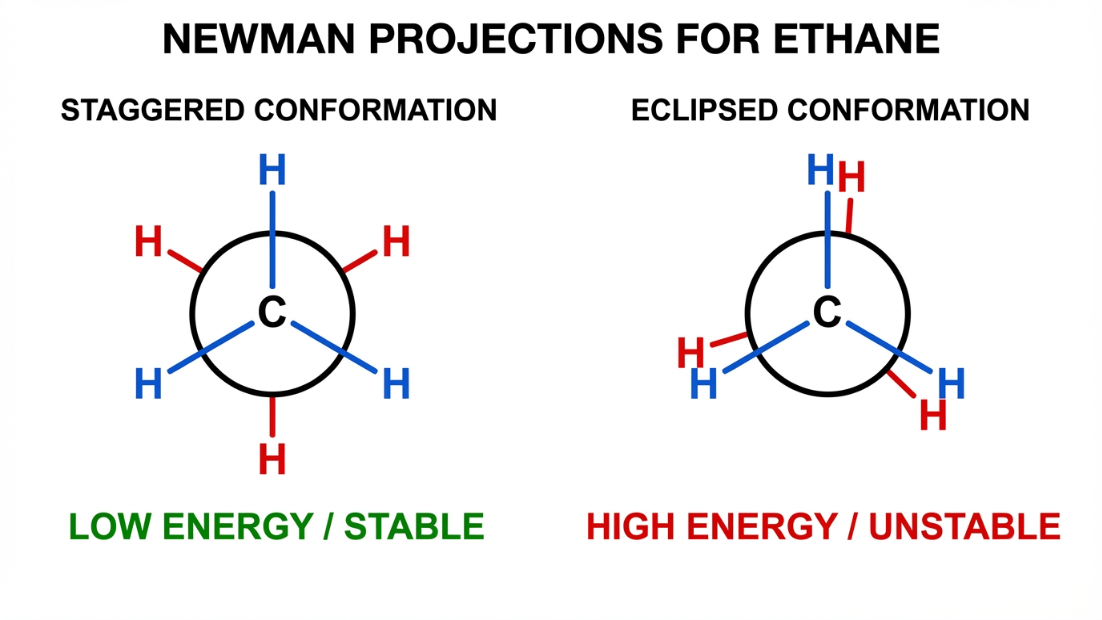
C-C single bonds allow free rotation. The different spatial arrangements arising from this rotation are called conformations. For Ethane ($CH_3-CH_3$):
Staggered Conformation: The hydrogen atoms of one carbon are as far apart as possible from the hydrogens of the other carbon. Most stable (minimum torsional strain).
Eclipsed Conformation: The hydrogens of one carbon are directly in front of the hydrogens of the other carbon. Least stable (maximum torsional strain/repulsion).
B. Wurtz Reaction (Stepping up the chain)
A crucial reaction for converting lower alkyl halides into higher symmetrical alkanes using Sodium metal in dry ether.
Mechanism
Proceeds via a Free Radical Mechanism in three steps:
Initiation: Homolytic cleavage of the $Cl-Cl$ bond by UV light.
$Cl_2 \xrightarrow{h\nu} 2Cl^\bullet$
Propagation: The chlorine radical attacks the alkane, generating an alkyl radical. The alkyl radical then attacks a new $Cl_2$ molecule.
$CH_4 + Cl^\bullet \rightarrow CH_3^\bullet + HCl$
$CH_3^\bullet + Cl_2 \rightarrow CH_3Cl + Cl^\bullet$ (The chain continues!)
Termination: Any two radicals collide and combine, stopping the chain.
2. Alkenes: Electrophilic Addition Reactions
The $\pi$ bond in alkenes is a rich source of exposed electrons, making them highly susceptible to attack by Electrophiles ($E^+$).
A. Addition of Hydrogen Halides (HX) & Markovnikov's Rule
When an unsymmetrical reagent (like $HBr$, $HCl$) adds to an unsymmetrical alkene (like Propene), the reaction follows Markovnikov's Rule.
Markovnikov's Rule"The negative part of the addendum (e.g., $Br^-$) gets attached to that carbon atom of the double bond which possesses a lesser number of hydrogen atoms." Shortcut: "The rich get richer." The carbon that already has more hydrogens gets the new hydrogen.
Mechanism (Why does this happen?):
$CH_3-CH=CH_2 + H^+ \rightarrow$ Path 1: $H^+$ attacks $C_1$, creating $CH_3-CH^+-CH_3$ (A stable $2^\circ$ Carbocation. Major) Path 2: $H^+$ attacks $C_2$, creating $CH_3-CH_2-CH_2^+$ (An unstable $1^\circ$ Carbocation. Minor)
The nucleophile ($Br^-$) then attacks the more stable $2^\circ$ carbocation to form 2-Bromopropane.
Class 12 Ultimate Trap: Carbocation Rearrangement
Because this reaction forms an intermediate carbocation, it will rearrange if it can become more stable!
If a $2^\circ$ carbocation is formed next to a $3^\circ$ or $4^\circ$ carbon, a Hydride Shift ($\sim H^-$) or Methide Shift ($\sim CH_3^-$) will occur *before* the halogen attacks. Example: Addition of HCl to 3-Methylbut-1-ene yields 2-Chloro-2-methylbutane (rearranged product), NOT 2-Chloro-3-methylbutane.
B. Anti-Markovnikov Addition (Peroxide / Kharasch Effect)
If $HBr$ is added to an unsymmetrical alkene in the presence of organic peroxides (like benzoyl peroxide), the addition occurs opposite to Markovnikov's rule.
Important: This ONLY works with $HBr$. It does not work with $HCl$ or $HI$.
Mechanism: Instead of carbocations, this reaction proceeds via a Free Radical Mechanism. The peroxide generates a $Br^\bullet$ radical, which attacks the alkene to form the most stable alkyl radical (a $2^\circ$ radical), placing the $Br$ on the terminal carbon (forming 1-Bromopropane).
C. Hydration of Alkenes
Alkenes react with water in the presence of a few drops of concentrated acid (like $H_2SO_4$ as a catalyst) to form alcohols. This is an electrophilic addition that strictly follows Markovnikov's Rule (and is also subject to carbocation rearrangements).
Ozone ($O_3$) cleaves the $C=C$ double bond entirely. Followed by reduction with Zinc dust and water ($Zn/H_2O$), it produces aldehydes and/or ketones. This is a massive tool for structural identification in Class 12.
Shortcut Trick:
1. Erase the double bond entirely ($=$ becomes two separate pieces).
2. Stick a double-bonded Oxygen ($=O$) onto both broken ends. Example: $CH_3-CH=CH_2 \xrightarrow{1. O_3, \text{ } 2. Zn/H_2O} CH_3-CH=O \text{ (Ethanal)} + O=CH_2 \text{ (Methanal)}$
3. Alkynes: Acidic Character & Hydration
A. Acidic Character of Terminal Alkynes
The carbon atoms in a triple bond are sp hybridized (50% s-character). The electrons are pulled very close to the nucleus, making the $sp$ carbon highly electronegative. It strongly pulls the shared electrons of the $C-H$ bond, allowing the Hydrogen atom to leave easily as a proton ($H^+$).
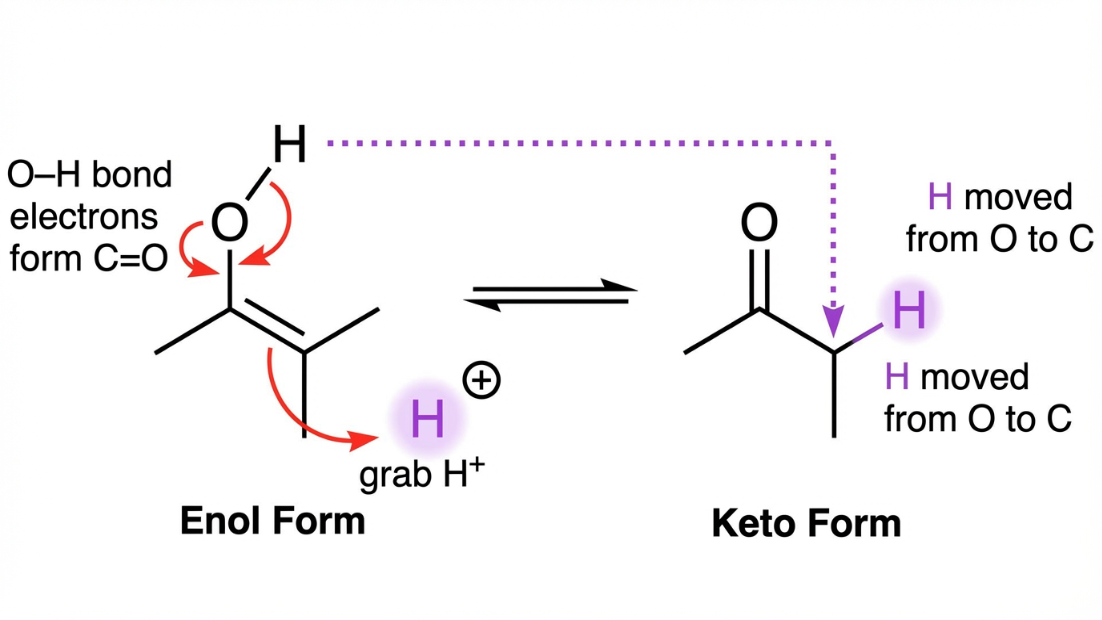
This is a critical prep method for Aldehydes/Ketones in Class 12. Alkynes undergo hydration when warmed with water in the presence of $H_2SO_4$ and Mercuric sulfate ($HgSO_4$) as a catalyst.
The initial addition of water (following Markovnikov's rule) forms an unstable "Enol" (Alkene + Alcohol). This rapidly rearranges into a stable "Keto" form (Aldehyde or Ketone) via Tautomerization.
4. Benzene (Arenes) and Electrophilic Substitution
Benzene ($C_6H_6$) has a cyclic cloud of 6 delocalized $\pi$ electrons (Resonance). This incredible stability (Resonance Energy) means Benzene refuses to undergo addition reactions (which would break the aromatic ring). Instead, it undergoes Electrophilic Aromatic Substitution ($S_EAr$), replacing a hydrogen atom with an electrophile.
General Mechanism of $S_EAr$
Generation of Electrophile ($E^+$): Using a Lewis acid catalyst.
Formation of Carbocation (Sigma Complex / Arenium Ion): The $\pi$ cloud attacks the $E^+$, breaking the aromaticity. This intermediate is resonance-stabilized but non-aromatic.
Removal of Proton: The catalyst rips a proton ($H^+$) off the ring, restoring the beloved aromatic $\pi$ cloud!
The 5 Core Substitution Reactions (Memorize Electrophile Generation)
Nitration: Reagents: Conc. $HNO_3$ + Conc. $H_2SO_4$.
Electrophile: Nitronium Ion ($NO_2^+$). ($H_2SO_4$ acts as an acid, forcing $HNO_3$ to act as a base and lose $OH^-$!)
Halogenation: Reagents: $Cl_2$ + Anhydrous $AlCl_3$ or $FeCl_3$.
Electrophile: Chloronium Ion ($Cl^+$).
The Cumene Trap (Friedel-Crafts Rearrangement)
In FC Alkylation, a free carbocation is generated. It will rearrange!
If you react Benzene with n-Propyl chloride ($CH_3CH_2CH_2Cl$) and $AlCl_3$, the initial $1^\circ$ carbocation ($CH_3CH_2CH_2^+$) rapidly undergoes a hydride shift to become a stable $2^\circ$ carbocation ($CH_3C^+HCH_3$). Result: The product is Isopropylbenzene (Cumene), NOT n-Propylbenzene.
5. Directive Influence of Functional Groups
If a benzene ring already has a group attached, where will the *second* incoming electrophile go? The first group acts as a "traffic cop."
Ortho-Para Directing Groups (Activating)
Groups that push electron density into the ring via +R (Resonance) effect. They make the Ortho and Para positions highly electron-rich (negative), which perfectly attracts the positive electrophile. They activate the ring (make it react faster than bare benzene). Examples: $-OH, -NH_2, -OR, -CH_3$ (alkyl groups work via hyperconjugation).
Meta Directing Groups (Deactivating)
Groups with a multiple bond to a more electronegative atom pull electrons out of the ring via -R effect. They place a positive charge on the Ortho and Para positions. The electrophile (which is positive) avoids these spots and goes to the Meta position by default. They deactivate the ring (react slower). Examples: $-NO_2, -CHO, -COOH, -CN, -SO_3H$.
Practice Problem 1Question: Predict the major product(s) when Toluene (Methylbenzene) is treated with a mixture of concentrated $HNO_3$ and $H_2SO_4$.
Solution:
1. Identify the reagents: Conc. $HNO_3$ and $H_2SO_4$ is the nitration mixture. It generates the $NO_2^+$ electrophile.
2. Identify the group already on the ring: The $-CH_3$ (methyl) group.
3. Determine directive influence: Alkyl groups are electron-donating via hyperconjugation (+I effect). Therefore, they are Ortho-Para directing and activating.
4. Predict Products: The $NO_2^+$ will attack the ortho and para positions. Major Products: A mixture of o-Nitrotoluene and p-Nitrotoluene. (Usually, the para isomer is the dominant major product due to less steric hindrance).