Vardaan Learning Institute
Class 11 Mathematics • Chapter Notes
🌐 vardaanlearning.com📞 9508841336
Module 2: Trigonometry
Dear Class 12 Student! Listen carefully: Trigonometry is the language of Calculus. If you do not know the $\cos 2x$ formulas by heart, you will completely fail at Integration. If you do not know transformation formulas, you cannot differentiate complex functions. This module is arguably the most critical prerequisite for your entire Class 12 Mathematics journey. Memorize these formulas until they become second nature.
1. Measurement of Angles (Degrees vs. Radians)
In classical geometry, we measure angles in degrees. However, in Calculus, all angles are measured in Radians. This is because formulas like $\frac{d}{dx}(\sin x) = \cos x$ are mathematically invalid if $x$ is in degrees!
The Golden Conversion
$$\pi \text{ radians} = 180^\circ$$
- To convert Degrees to Radians: Multiply by $\frac{\pi}{180}$
- To convert Radians to Degrees: Multiply by $\frac{180}{\pi}$
Key values to memorize instantly: $30^\circ = \frac{\pi}{6}$, $45^\circ = \frac{\pi}{4}$, $60^\circ = \frac{\pi}{3}$, $90^\circ = \frac{\pi}{2}$, $270^\circ = \frac{3\pi}{2}$.
Practice Problem 1
Question: Convert $40^\circ 20'$ (40 degrees and 20 minutes) into radian measure.
Solution:
We know that $60' = 1^\circ$. Therefore, $20' = \left(\frac{20}{60}\right)^\circ = \frac{1}{3}^\circ$.
Total angle in degrees = $40 \frac{1}{3}^\circ = \frac{121}{3}^\circ$.
Now, convert to radians:
Radians = $\frac{121}{3} \times \frac{\pi}{180} = \mathbf{\frac{121\pi}{540} \text{ rad}}$
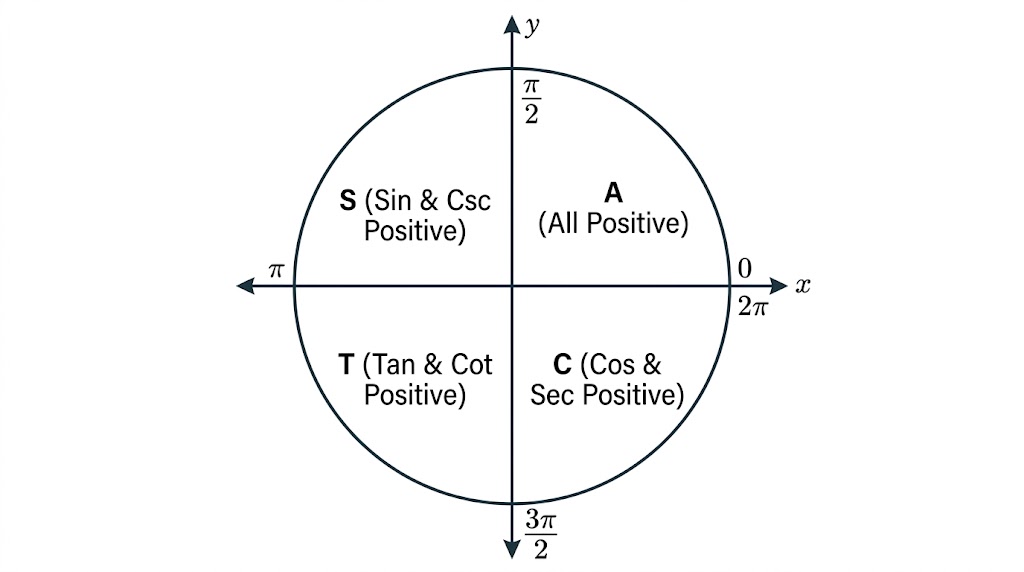
2. Sign of Trigonometric Functions (ASTC Rule)
When an angle exceeds $90^\circ$ ($\pi/2$), it enters other quadrants where trig functions take specific signs.
All Sin Tan Cos (ASTC) / "Add Sugar To Coffee"
- Quadrant I ($0$ to $\pi/2$): All trig functions are Positive.
- Quadrant II ($\pi/2$ to $\pi$): Only $\sin x$ and $\csc x$ are Positive.
- Quadrant III ($\pi$ to $3\pi/2$): Only $\tan x$ and $\cot x$ are Positive.
- Quadrant IV ($3\pi/2$ to $2\pi$): Only $\cos x$ and $\sec x$ are Positive.
Reduction Formulas (Allied Angles)
- $\frac{\pi}{2} \pm \theta$ or $\frac{3\pi}{2} \pm \theta$ (Y-axis reference): The function CHANGES to its co-function ($\sin \leftrightarrow \cos$, $\tan \leftrightarrow \cot$, $\sec \leftrightarrow \csc$). The sign is determined by ASTC.
Example: $\sin(\frac{\pi}{2} + \theta) = +\cos \theta$ (Q II, sin is +). $\cos(\frac{\pi}{2} + \theta) = -\sin \theta$ (Q II, cos is -).
- $\pi \pm \theta$ or $2\pi \pm \theta$ (X-axis reference): The function REMAINS THE SAME. The sign is determined by ASTC.
Example: $\sin(\pi - \theta) = +\sin \theta$ (Q II). $\tan(\pi + \theta) = +\tan \theta$ (Q III). $\cos(2\pi - \theta) = +\cos \theta$ (Q IV).
3. Trigonometric Functions and their Graphs
You must know the exact Domain and Range to solve Inverse Trigonometry in Class 12.
| Function |
Domain (Input) |
Range (Output) |
| $y = \sin x$ |
$\mathbb{R}$ (All real numbers) |
$[-1, 1]$ |
| $y = \cos x$ |
$\mathbb{R}$ |
$[-1, 1]$ |
| $y = \tan x$ |
$\mathbb{R} - \{(2n+1)\frac{\pi}{2}\}$ (Where $\cos x = 0$) |
$\mathbb{R}$ |
| $y = \sec x$ |
$\mathbb{R} - \{(2n+1)\frac{\pi}{2}\}$ |
$(-\infty, -1] \cup [1, \infty)$ |
4. Compound Angle Formulas
These formulas are the building blocks for all advanced trigonometry.
Memorize These
- $\sin(A + B) = \sin A \cos B + \cos A \sin B$
- $\sin(A - B) = \sin A \cos B - \cos A \sin B$
- $\cos(A + B) = \cos A \cos B \mathbf{-} \sin A \sin B$ (Notice the sign flip!)
- $\cos(A - B) = \cos A \cos B \mathbf{+} \sin A \sin B$
- $\tan(A + B) = \frac{\tan A + \tan B}{1 - \tan A \tan B}$
- $\tan(A - B) = \frac{\tan A - \tan B}{1 + \tan A \tan B}$
Practice Problem 2
Question: Find the exact value of $\tan 75^\circ$.
Solution:
We can write $75^\circ$ as a sum of standard angles: $45^\circ + 30^\circ$.
$\tan 75^\circ = \tan(45^\circ + 30^\circ)$
Apply the formula: $\tan(A + B) = \frac{\tan A + \tan B}{1 - \tan A \tan B}$
$\tan(45^\circ + 30^\circ) = \frac{\tan 45^\circ + \tan 30^\circ}{1 - \tan 45^\circ \tan 30^\circ}$
Substitute values ($\tan 45^\circ = 1$, $\tan 30^\circ = \frac{1}{\sqrt{3}}$):
$= \frac{1 + \frac{1}{\sqrt{3}}}{1 - (1)(\frac{1}{\sqrt{3}})} = \frac{\frac{\sqrt{3} + 1}{\sqrt{3}}}{\frac{\sqrt{3} - 1}{\sqrt{3}}} = \frac{\sqrt{3} + 1}{\sqrt{3} - 1}$
Rationalizing the denominator:
$= \frac{(\sqrt{3} + 1)(\sqrt{3} + 1)}{(\sqrt{3} - 1)(\sqrt{3} + 1)} = \frac{3 + 1 + 2\sqrt{3}}{3 - 1} = \frac{4 + 2\sqrt{3}}{2} = \mathbf{2 + \sqrt{3}}$
5. Multiple and Sub-Multiple Angles (The Calculus Lifeline)
If you forget these, you cannot do Integral Calculus. Period.
Double Angle Formulas
Sine Double Angle:
- $\sin 2x = 2 \sin x \cos x$
- $\sin 2x = \frac{2 \tan x}{1 + \tan^2 x}$
Cosine Double Angle (The Most Important set in Math):
- $\cos 2x = \cos^2 x - \sin^2 x$
- $\cos 2x = 2 \cos^2 x - 1$
- $\cos 2x = 1 - 2 \sin^2 x$
- $\cos 2x = \frac{1 - \tan^2 x}{1 + \tan^2 x}$
Tangent Double Angle:
- $\tan 2x = \frac{2 \tan x}{1 - \tan^2 x}$
The "Power Reduction" Integration Hack
In calculus, you cannot directly integrate $\sin^2 x$ or $\cos^2 x$. You MUST use the rearranged $\cos 2x$ formulas to reduce the power to 1:
$1 - \cos 2x = 2 \sin^2 x \implies \sin^2 x = \frac{1 - \cos 2x}{2}$
$1 + \cos 2x = 2 \cos^2 x \implies \cos^2 x = \frac{1 + \cos 2x}{2}$
Sub-multiple version: The angle simply halves. $1 - \cos x = 2 \sin^2(\frac{x}{2})$.
Practice Problem 3 (Calculus Prep)
Question: Simplify the expression $\sqrt{\frac{1 - \cos x}{1 + \cos x}}$ (assuming $x \in (0, \pi)$).
Solution:
Using the sub-multiple power reduction formulas:
Numerator: $1 - \cos x = 2 \sin^2(x/2)$
Denominator: $1 + \cos x = 2 \cos^2(x/2)$
Substitute these into the expression:
$\sqrt{\frac{2 \sin^2(x/2)}{2 \cos^2(x/2)}} = \sqrt{\tan^2(x/2)}$
Since $x \in (0, \pi)$, then $x/2 \in (0, \pi/2)$. In the first quadrant, $\tan(x/2)$ is positive, so the square root simply gives:
$= \tan(x/2)$
(This exact simplification is required in Inverse Trigonometric derivatives in Class 12!)
6. Transformation Formulas
Used to convert products into sums (useful for integration) or sums into products (useful for solving trigonometric equations).
A. Sum to Product (C & D Formulas)
- $\sin C + \sin D = 2 \sin(\frac{C+D}{2}) \cos(\frac{C-D}{2})$
- $\sin C - \sin D = 2 \cos(\frac{C+D}{2}) \sin(\frac{C-D}{2})$
- $\cos C + \cos D = 2 \cos(\frac{C+D}{2}) \cos(\frac{C-D}{2})$
- $\cos C - \cos D = -2 \sin(\frac{C+D}{2}) \sin(\frac{C-D}{2})$ (Don't forget the negative sign!)
B. Product to Sum (Integration Helpers)
- $2 \sin A \cos B = \sin(A+B) + \sin(A-B)$
- $2 \cos A \sin B = \sin(A+B) - \sin(A-B)$
- $2 \cos A \cos B = \cos(A+B) + \cos(A-B)$
- $2 \sin A \sin B = \cos(A-B) - \cos(A+B)$
Practice Problem 4
Question: Express $\cos 4x \cos 2x$ as a sum or difference of cosines.
Solution:
We need the formula: $2 \cos A \cos B = \cos(A+B) + \cos(A-B)$.
The expression is missing the '2'. Multiply and divide by 2:
$\frac{1}{2} [2 \cos 4x \cos 2x]$
Let $A = 4x$ and $B = 2x$. Apply the formula inside the bracket:
$= \frac{1}{2} [\cos(4x + 2x) + \cos(4x - 2x)]$
$= \mathbf{\frac{1}{2} [\cos 6x + \cos 2x]}$
(This is how you integrate products of sine and cosine in Class 12!)
MEGA PRACTICE BANK
Problem 5: Quadrant Logic (ASTC)
Question: If $\sin x = \frac{3}{5}$ and $x$ lies in the second quadrant ($\frac{\pi}{2} < x < \pi$), find the value of $\tan 2x$.
Solution:
Step 1: Find $\cos x$ and $\tan x$.
We know $\sin^2 x + \cos^2 x = 1 \implies \cos^2 x = 1 - (3/5)^2 = 16/25$.
Since $x$ is in Q-II, $\cos x$ is negative. Therefore, $\cos x = -\frac{4}{5}$.
Then, $\tan x = \frac{\sin x}{\cos x} = \frac{3/5}{-4/5} = -\frac{3}{4}$.
Step 2: Apply the Double Angle Formula.
$\tan 2x = \frac{2\tan x}{1 - \tan^2 x}$
$\tan 2x = \frac{2(-3/4)}{1 - (-3/4)^2} = \frac{-6/4}{1 - 9/16} = \frac{-3/2}{7/16} = -\frac{3}{2} \times \frac{16}{7} = \mathbf{-\frac{24}{7}}$.
$\tan 2x = \frac{2(-3/4)}{1 - (-3/4)^2} = \frac{-6/4}{1 - 9/16} = \frac{-3/2}{7/16} = -\frac{3/2} \times \frac{16}{7} = \mathbf{-\frac{24}{7}}$.
Problem 6: Calculus Simplification
Question: Prove that $\frac{\sin x + \sin 3x}{\cos x + \cos 3x} = \tan 2x$.
Solution:
Apply the Sum-to-Product (C & D) formulas on both numerator and denominator.
Numerator: $\sin 3x + \sin x = 2 \sin(\frac{3x+x}{2}) \cos(\frac{3x-x}{2}) = 2 \sin 2x \cos x$.
Denominator: $\cos 3x + \cos x = 2 \cos(\frac{3x+x}{2}) \cos(\frac{3x-x}{2}) = 2 \cos 2x \cos x$.
Substitute back into the fraction:
$\frac{2 \sin 2x \cos x}{2 \cos 2x \cos x}$
Cancel out the common terms ($2$ and $\cos x$):
$= \frac{\sin 2x}{\cos 2x} = \mathbf{\tan 2x}$. (Hence Proved)
Problem 7: Power Reduction Identity
Question: Express $\cos^4 x$ in terms of cosines of multiple angles (This factorization is mandatory for solving the integral $\int \cos^4 x dx$).
Solution:
We know the power reduction formula: $\cos^2 x = \frac{1 + \cos 2x}{2}$.
So, $\cos^4 x = (\cos^2 x)^2 = \left(\frac{1 + \cos 2x}{2}\right)^2$
Expand the square: $= \frac{1 + 2\cos 2x + \cos^2 2x}{4}$
Now, we have another square term, $\cos^2 2x$. Apply the formula again directly on it!
$\cos^2 2x = \frac{1 + \cos 4x}{2}$
Substitute this back into the expression:
$= \frac{1 + 2\cos 2x + \frac{1 + \cos 4x}{2}}{4}$
Multiply numerator and denominator by 2 to clear fractions:
$= \frac{2 + 4\cos 2x + 1 + \cos 4x}{8}$
Combine constants:
$= \frac{3}{8} + \frac{1}{2}\cos 2x + \frac{1}{8}\cos 4x$.