Vardaan Learning Institute
Class 11 Mathematics • Chapter Notes
🌐 vardaanlearning.com📞 9508841336
Module 4: Limits and Derivatives
Dear Class 12 Student! Limits and Derivatives is the gatekeeper of Class 12. The entire first half of your Class 12 syllabus (Continuity, Differentiability, Application of Derivatives, and Integrals) is built on these two concepts. If you cannot solve a limit or differentiate a basic function using the Product Rule, Class 12 will feel like a nightmare. Let's fix that now!
1. Concept of a Limit
A limit describes how a function behaves as its input approaches a specific value, even if the function is not defined at that exact value. We write this as $\lim_{x \to a} f(x) = L$.
Condition for Existence
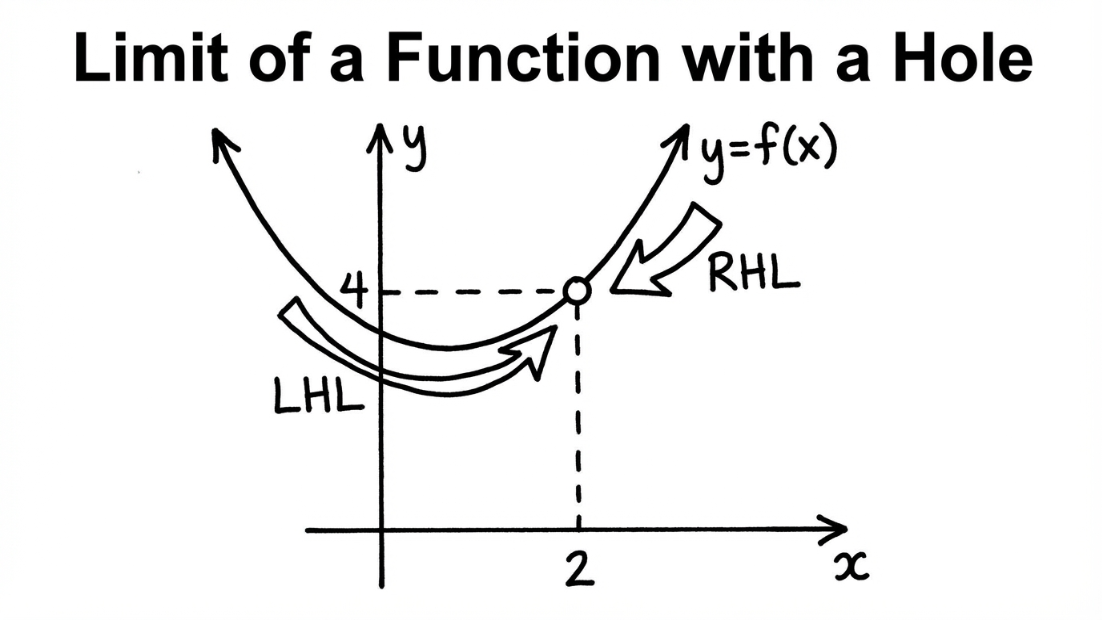
A limit exists at $x = a$
if and only if the Left Hand Limit (LHL) and Right Hand Limit (RHL) are equal and finite:
$$\lim_{x \to a^-} f(x) = \lim_{x \to a^+} f(x) = L$$
- LHL: Approaching $a$ from values slightly less than $a$. ($x = a - h$, where $h \to 0$)
- RHL: Approaching $a$ from values slightly more than $a$. ($x = a + h$, where $h \to 0$)
Topic 1 Check
Question: Given $f(x) = \begin{cases} 2x+1, & x < 3 \\ 10, & x=3 \\ x^2 - 2, & x > 3 \end{cases}$. Does $\lim_{x \to 3} f(x)$ exist?
Solution: Check LHL and RHL.
LHL: $\lim_{x \to 3^-} (2x+1) = 2(3)+1 = 7$.
RHL: $\lim_{x \to 3^+} (x^2-2) = (3^2)-2 = 7$.
Since LHL = RHL = 7, the limit exists and equals 7 (even though $f(3)=10$).
2. Algebra of Limits
Assuming $\lim_{x \to a} f(x) = L$ and $\lim_{x \to a} g(x) = M$ exist:
- Sum/Difference: $\lim [f(x) \pm g(x)] = L \pm M$
- Product: $\lim [f(x) \cdot g(x)] = L \cdot M$
- Quotient: $\lim \frac{f(x)}{g(x)} = \frac{L}{M}$, provided $M \neq 0$.
Topic 2 Check
Question: Evaluate $\lim_{x \to 2} \frac{x^2 - 4}{x+2}$.
Solution: Since the denominator does not equal zero at $x=2$, we can apply the quotient theorem directly via direct substitution.
$= \frac{2^2 - 4}{2+2} = \frac{0}{4} = \mathbf{0}$.
3. Standard Limits to Memorize
The Golden Formulas
- Polynomial Type: $$\lim_{x \to a} \frac{x^n - a^n}{x - a} = na^{n-1}$$
- Trigonometric Type: $$\lim_{x \to 0} \frac{\sin x}{x} = 1 \quad \text{and} \quad \lim_{x \to 0} \frac{\tan x}{x} = 1$$
- Exponential Type: $$\lim_{x \to 0} \frac{e^x - 1}{x} = 1$$
- Logarithmic Type: $$\lim_{x \to 0} \frac{\ln(1+x)}{x} = 1$$
Practice Problem 1
Question: Evaluate $\lim_{x \to 0} \frac{\sin 5x}{3x}$.
Solution:
$\frac{1}{3} \lim_{x \to 0} \frac{\sin 5x}{x} = \frac{5}{3} \lim_{x \to 0} \frac{\sin 5x}{5x} = \frac{5}{3} \times 1 = \mathbf{\frac{5}{3}}$.
4. Derivatives: The Rate of Change
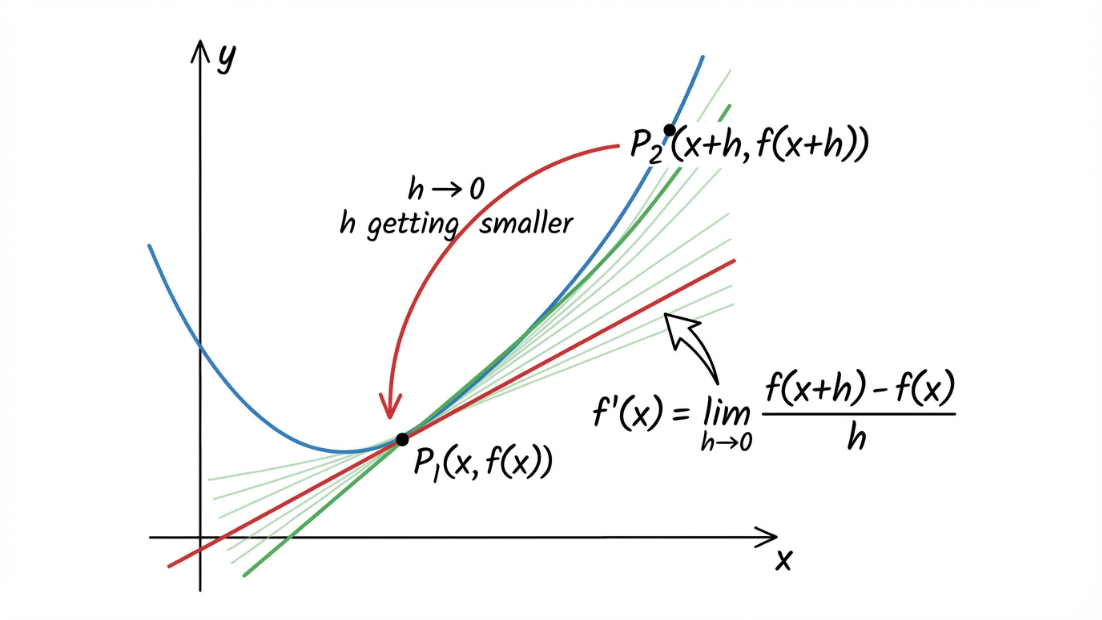
A derivative represents the instantaneous rate of change of a function. Geometrically, it is the slope of the tangent to the curve at a given point.
The First Principle of Differentiation
$$f'(x) = \lim_{h \to 0} \frac{f(x+h) - f(x)}{h}$$
Topic 4 Check
Question: True or False: Geometrically, the derivative is the slope of the secant line connecting two points.
Solution: False. The secant line connects two distinct points. The derivative is the slope of the tangent line at a single exact point, which occurs when the two points converge ($h \to 0$).
5. Rules of Differentiation
Memorize These Rules
- Power Rule: $\frac{d}{dx}(x^n) = nx^{n-1}$
- Product Rule: $\frac{d}{dx}(uv) = uv' + vu'$
- Quotient Rule: $\frac{d}{dx}\left(\frac{u}{v}\right) = \frac{vu' - uv'}{v^2}$
Topic 5 Check
Question: Identify the mathematical error in this differentiation block: $\frac{d}{dx}(x^3 \sin x) = (3x^2)(\cos x)$.
Solution: The error is assuming the derivative of a product is the product of derivatives. You cannot just multiply the individual derivatives.
You must use the Product Rule: $uv' + vu'$.
Correct derivative is: $\mathbf{(x^3)(\cos x) + (\sin x)(3x^2)}$.
6. Derivatives of Standard Functions
| Function $f(x)$ |
Derivative $f'(x)$ |
| $x^n$ |
$nx^{n-1}$ |
| $\sin x$ |
$\cos x$ |
| $\cos x$ |
$-\sin x$ |
| $\tan x$ |
$\sec^2 x$ |
| $\sec x$ |
$\sec x \tan x$ |
| $e^x$ |
$e^x$ |
| $\ln x$ |
$1/x$ |
Topic 6 Check
Question: What is $\frac{d}{dx}(x^2 - 3\tan x + 5e^x)$?
Solution: Apply the sum/difference rule and the standard formulas.
$\frac{d}{dx}(x^2) = 2x$
$\frac{d}{dx}(-3\tan x) = -3\sec^2 x$
$\frac{d}{dx}(5e^x) = 5e^x$
Answer: $\mathbf{2x - 3\sec^2 x + 5e^x}$.
MEGA PRACTICE BANK
Problem 2: Limit Factorization (0/0 Form)
Question: Evaluate $\lim_{x \to 3} \frac{x^2 - 9}{x^2 - 5x + 6}$.
Solution: Direct substitution yields $\frac{0}{0}$. We must factorize.
Numerator: $x^2 - 9 = (x - 3)(x + 3)$
Denominator: $x^2 - 5x + 6 = (x - 3)(x - 2)$
Cancel the $(x - 3)$ term:
$\lim_{x \to 3} \frac{x + 3}{x - 2} = \frac{3 + 3}{3 - 2} = \frac{6}{1} = \mathbf{6}$.
Problem 3: Product Rule Mechanics
Question: Differentiate $y = x^2 \sin x$.
Solution: Let $u = x^2$ and $v = \sin x$.
Apply Product Rule: $y' = u v' + v u'$
$y' = (x^2)(\cos x) + (\sin x)(2x) = \mathbf{x^2 \cos x + 2x \sin x}$.
Problem 4: Quotient Rule Mechanics
Question: Differentiate $y = \frac{x+1}{x-1}$.
Solution: Let $u = x+1, u' = 1$ and $v = x-1, v' = 1$.
Apply Quotient Rule: $y' = \frac{v u' - u v'}{v^2}$
$y' = \frac{(x-1)(1) - (x+1)(1)}{(x-1)^2}$
$y' = \frac{x - 1 - x - 1}{(x-1)^2} = \mathbf{\frac{-2}{(x-1)^2}}$.
Problem 5: First Principle Derivation
Question: Use the First Principle of differentiation to find the derivative of $f(x) = x^2$.
Solution: $f'(x) = \lim_{h \to 0} \frac{f(x+h) - f(x)}{h}$
$f'(x) = \lim_{h \to 0} \frac{(x+h)^2 - x^2}{h}$
Expand the square: $f'(x) = \lim_{h \to 0} \frac{x^2 + 2xh + h^2 - x^2}{h}$
$f'(x) = \lim_{h \to 0} \frac{2xh + h^2}{h} = \lim_{h \to 0} (2x + h)$
As $h \to 0, f'(x) = \mathbf{2x}$. This mathematically proves the Power Rule!
Problem 6: Mixed Derivative
Question: Differentiate $y = e^x \tan x$.
Solution: Apply Product Rule ($uv' + vu'$).
$u = e^x \implies u' = e^x$
$v = \tan x \implies v' = \sec^2 x$
$y' = e^x(\sec^2 x) + \tan x(e^x)$
Factoring out $e^x$: $y' = \mathbf{e^x (\sec^2 x + \tan x)}$.