Vardaan Learning Institute
Class 11 Mathematics • Chapter Notes
🌐 vardaanlearning.com📞 9508841336
Module 6: Basic Probability
Dear Class 12 Student! Probability is one of the most scoring and intuitive chapters in Class 12. It builds directly upon the concepts of Sets and Sample Spaces you learned in Class 11. Whether you're calculating the odds of a winning hand or predicting weather patterns, probability is the mathematics of uncertainty. Let's master the basics to prepare for Class 12!
Topic 2 Check (Part A)
Question: Consider the experiment of throwing a die. Let $A$ be the event of getting an even number and $B$ be the event of getting an odd number. Are $A$ and $B$ mutually exclusive and exhaustive?
Solution:
$S = \{1, 2, 3, 4, 5, 6\}$.
$A = \{2, 4, 6\}$ and $B = \{1, 3, 5\}$.
Mutually Exclusive check: $A \cap B = \phi$ (no common elements). Yes, they are mutually exclusive.
Exhaustive check: $A \cup B = \{1, 2, 3, 4, 5, 6\} = S$. Yes, they form the full sample space.
3. Axiomatic Approach to Probability
Probability is a measure of the likelihood of an event. For any event $E$ in a finite sample space $S$ where all outcomes are equally likely:
Formula
$$P(E) = \frac{\text{Number of outcomes favorable to E}}{\text{Total number of possible outcomes}} = \frac{n(E)}{n(S)}$$
Fundamental Axioms:
- $0 \le P(E) \le 1$ (Probability is always between 0 and 1).
- $P(S) = 1$.
- $P(A \cup B) = P(A) + P(B)$ if A and B are mutually exclusive.
- $P(E') = 1 - P(E)$ (Complementary event).
Practice Problem 1: Basic Dice
Question: Two dice are thrown. What is the probability that the sum of the numbers appearing on the dice is 8?
Solution:
1. Total outcomes $n(S) = 6 \times 6 = 36$.
2. Favorable outcomes for sum 8: $E = \{(2,6), (3,5), (4,4), (5,3), (6,2)\}$.
3. $n(E) = 5$.
4. $P(E) = \frac{n(E)}{n(S)} = \mathbf{\frac{5}{36}}$.
Topic 3 Check (Part B)
Question: A leap year is selected at random. What is the probability that it contains 53 Sundays?
Solution: A leap year has 366 days, which is precisely 52 weeks and 2 extra days.
The 52 weeks guarantee 52 Sundays. The remaining 2 consecutive days could be: (Sun, Mon), (Mon, Tue), (Tue, Wed), (Wed, Thu), (Thu, Fri), (Fri, Sat), (Sat, Sun).
$n(S) = 7$ possible pairs.
Favorable pairs containing Sunday: (Sun, Mon) and (Sat, Sun). $n(E) = 2$.
Probability = $\mathbf{2/7}$.
4. Addition Theorem of Probability
This theorem is used to find the probability of occurrence of at least one of two events (A or B).
Theorem
$$P(A \cup B) = P(A) + P(B) - P(A \cap B)$$
Why the subtraction? When you add $P(A)$ and $P(B)$, the overlapping region $(A \cap B)$ is counted twice. We subtract it once to correct the total.
Practice Problem 2: Card Mastery
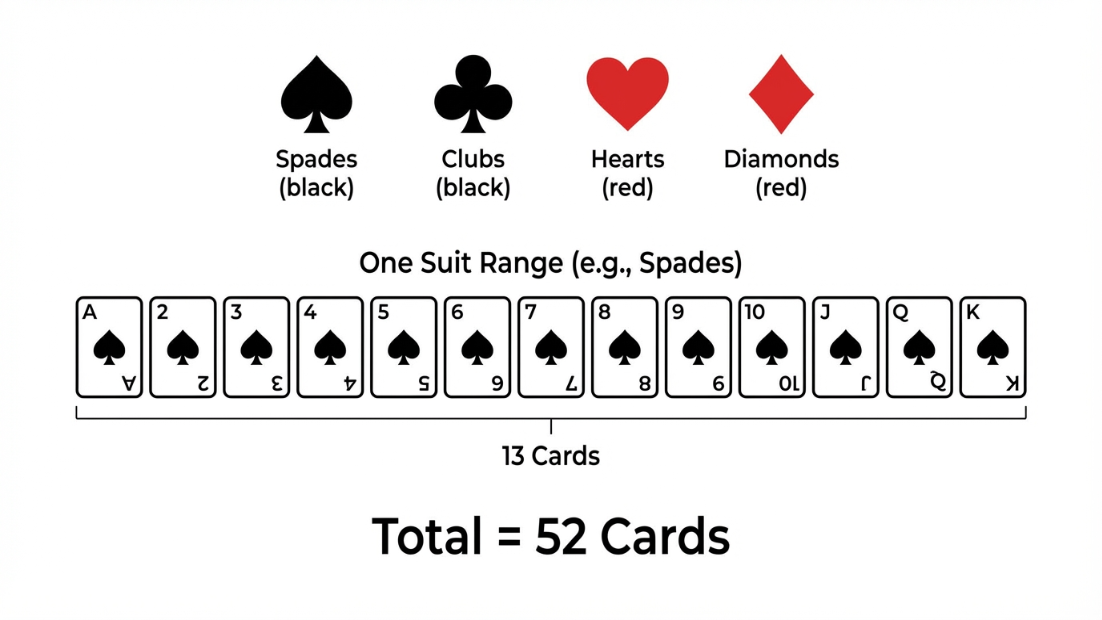
Question: A card is drawn from a well-shuffled pack of 52 cards. Find the probability that it is either a
King or a
Heart.
Solution:
1. $n(S) = 52$.
2. Let $A$ be the event of drawing a King. $n(A) = 4$ (4 Kings in a deck). $P(A) = 4/52$.
3. Let $B$ be the event of drawing a Heart. $n(B) = 13$ (13 Hearts in a deck). $P(B) = 13/52$.
4. $(A \cap B)$ is the event of drawing the King of Hearts. $n(A \cap B) = 1$. $P(A \cap B) = 1/52$.
5. By Addition Theorem: $P(A \cup B) = \frac{4}{52} + \frac{13}{52} - \frac{1}{52} = \frac{16}{52} = \mathbf{\frac{4}{13}}$.
Topic 4 Check (Part B)
Question: The probability that a student passes Math is $4/5$, and passing Physics is $2/3$. If the probability of passing both is $7/15$, what is the probability that the student passes at least one of them?
Solution: "At least one" means $P(M \cup P)$.
Using the Addition Theorem: $P(M \cup P) = P(M) + P(P) - P(M \cap P)$.
$P(M \cup P) = \frac{4}{5} + \frac{2}{3} - \frac{7}{15} = \frac{12}{15} + \frac{10}{15} - \frac{7}{15} = \frac{15}{15} = \mathbf{1}$.
It is a Sure Event the student passes at least one subject.
MEGA PRACTICE BANK (Class 12 Probability Prep)
Problem 3: Multiple Coins
Question: Three coins are tossed simultaneously. Find the probability of getting at least two heads.
Solution: $S = \{HHH, HHT, HTH, THH, HTT, THT, TTH, TTT\}$, $n(S) = 8$.
Favorable Outcomes (at least 2 H): $\{HHH, HHT, HTH, THH\}$. $n(E) = 4$.
$P(E) = 4/8 = \mathbf{1/2}$.
Problem 4: Mutually Exclusive Logic
Question: Events A and B are such that $P(A) = 0.4$, $P(B) = 0.5$ and $P(A \cup B) = 0.7$. Are events A and B mutually exclusive?
Solution: For Mutually Exclusive events, $P(A \cap B)$ must be 0.
Using $P(A \cup B) = P(A) + P(B) - P(A \cap B)$:
$0.7 = 0.4 + 0.5 - P(A \cap B) \implies 0.7 = 0.9 - P(A \cap B)$
$P(A \cap B) = 0.2$.
Since $P(A \cap B) \neq 0$, the events are NOT mutually exclusive.
Problem 5: Complementary Events
Question: The probability that it will rain tomorrow is $0.85$. What is the probability that it will NOT rain tomorrow?
Solution: $P(Not Rain) = 1 - P(Rain) = 1 - 0.85 = \mathbf{0.15}$.
Problem 6: Numbers and Sets
Question: A number is chosen at random from the first 20 natural numbers. Find the probability that it is a multiple of 3 or 7.
Solution: $n(S) = 20$.
$A$ (Multiples of 3): $\{3, 6, 9, 12, 15, 18\}$, $n(A) = 6$.
$B$ (Multiples of 7): $\{7, 14\}$, $n(B) = 2$.
$A \cap B$: Empty set (no multiple of 21 below 20).
$P(A \cup B) = \frac{6}{20} + \frac{2}{20} = \frac{8}{20} = \mathbf{0.4}$ or $\mathbf{2/5}$.
Problem 7: Combinatorics Approach
Question: Four cards are drawn from a well-shuffled deck of 52 cards. What is the probability of obtaining 3 diamonds and 1 spade?
Solution: This utilizes combinations since order doesn't matter.
Total ways to draw 4 cards from 52: $n(S) = ^{52}C_4$.
Favorable: Choose 3 from 13 diamonds ($^{13}C_3$) AND 1 from 13 spades ($^{13}C_1$).
$n(E) = ^{13}C_3 \times ^{13}C_1$.
$P(E) = \frac{^{13}C_3 \times ^{13}C_1}{^{52}C_4} = \mathbf{\frac{286 \times 13}{270725} = \frac{286}{20825}}$.