
In physics, we deal with two types of physical quantities based on how they are described:
Scalar Quantity: A physical quantity that has only magnitude (size or numerical value) but no direction. Examples: Mass, Time, Temperature, Speed, Energy, Distance, Work.
Vector Quantity: A physical quantity that has both magnitude and direction. Examples: Displacement, Velocity, Acceleration, Force, Momentum.
| Property | Scalar Quantity | Vector Quantity |
|---|---|---|
| Definition | Has only magnitude | Has both magnitude & direction |
| Representation | Simple number with unit | Arrow with length & direction |
| Examples | Mass, Time, Speed, Energy | Displacement, Velocity, Force |
| Addition Rule | Simple arithmetic addition | Vector addition laws required |
| Symbol | Normal letters ($m, t, E$) | Letters with arrow ($\vec{A}$) or bold ($\mathbf{A}$) |
🎯 Speed is scalar, but Velocity is vector! Distance is scalar, but Displacement is vector!
Vectors can be represented in two ways:
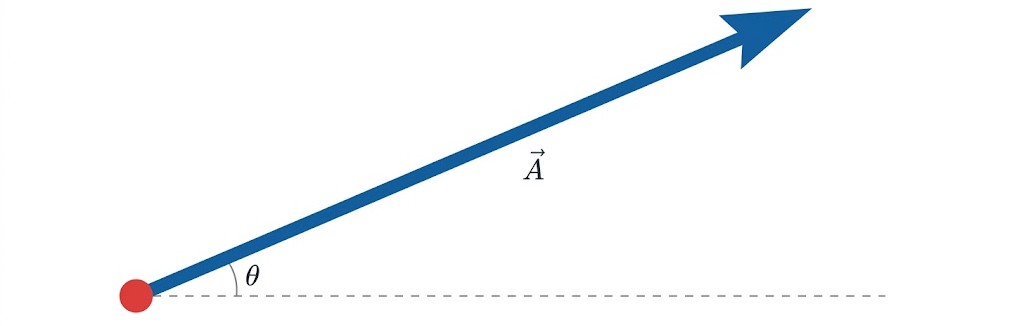 Vector Representation
A vector is represented by an arrow (directed line segment):
Unlike scalars, vectors cannot be added using simple arithmetic. We use special laws for vector addition.
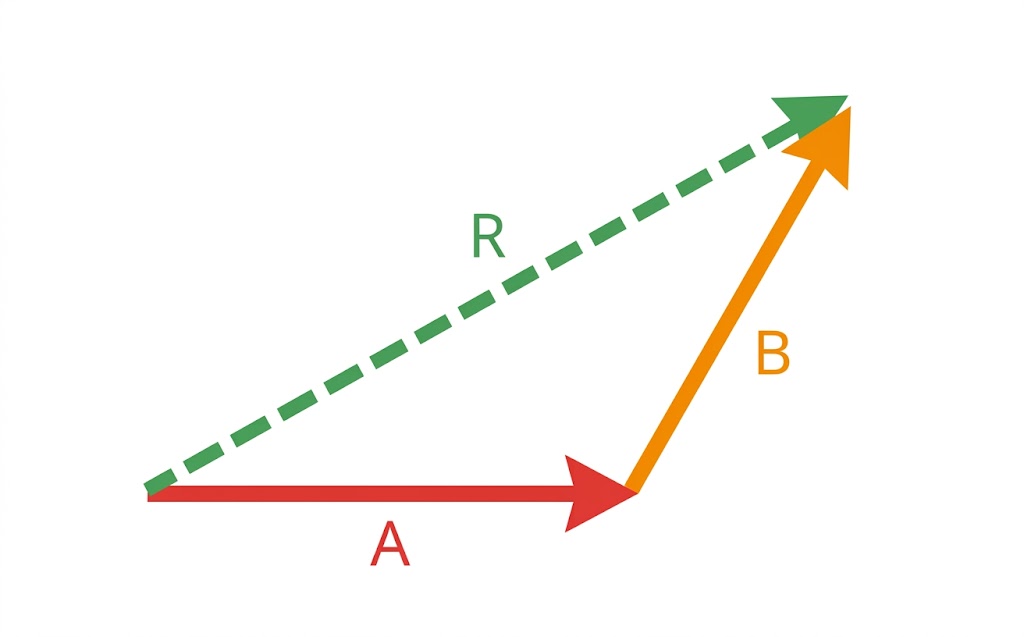 Triangle Law of Vector Addition
Statement: If two vectors are represented by two sides of a triangle taken in the same order (head to tail), then their resultant is represented by the third side of the triangle taken in the opposite order.
Steps to apply Triangle Law:
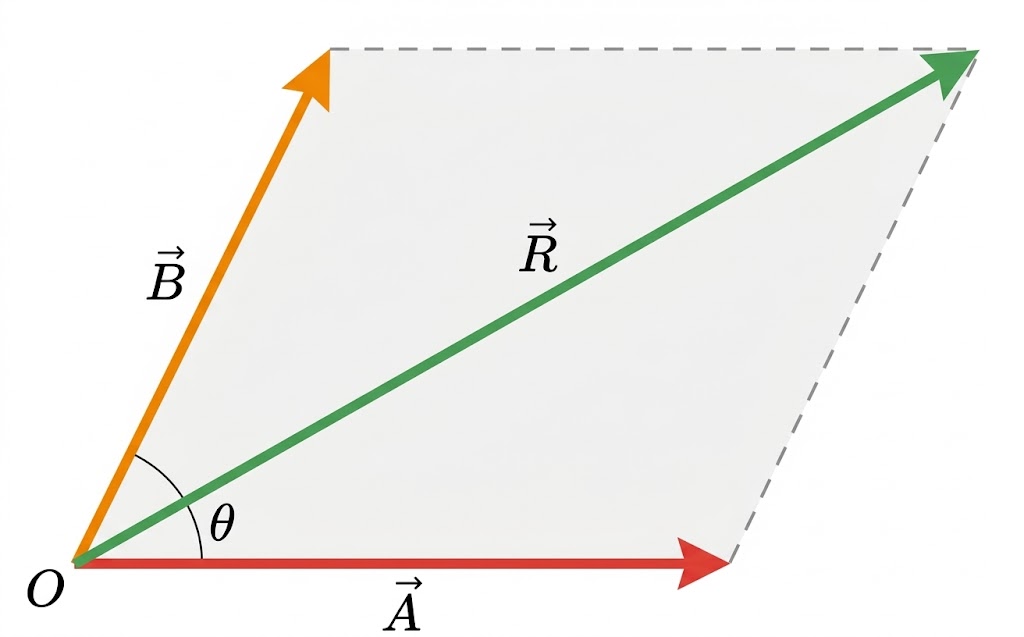 Parallelogram Law of Vector Addition
Statement: If two vectors acting at a point are represented by two adjacent sides of a parallelogram, then their resultant is represented by the diagonal of the parallelogram passing through that point.
Where $\theta$ is the angle between vectors $\vec{A}$ and $\vec{B}$.
1. Same Direction ($\theta = 0^\circ$): $R = A + B$ (Maximum resultant)
2. Opposite Direction ($\theta = 180^\circ$): $R = |A - B|$ (Minimum resultant)
3. Perpendicular ($\theta = 90^\circ$): $R = \sqrt{A^2 + B^2}$ (Pythagorean theorem)
4. Equal Vectors ($A = B$): $R = 2A \cos(\theta/2)$ (Resultant bisects the angle)
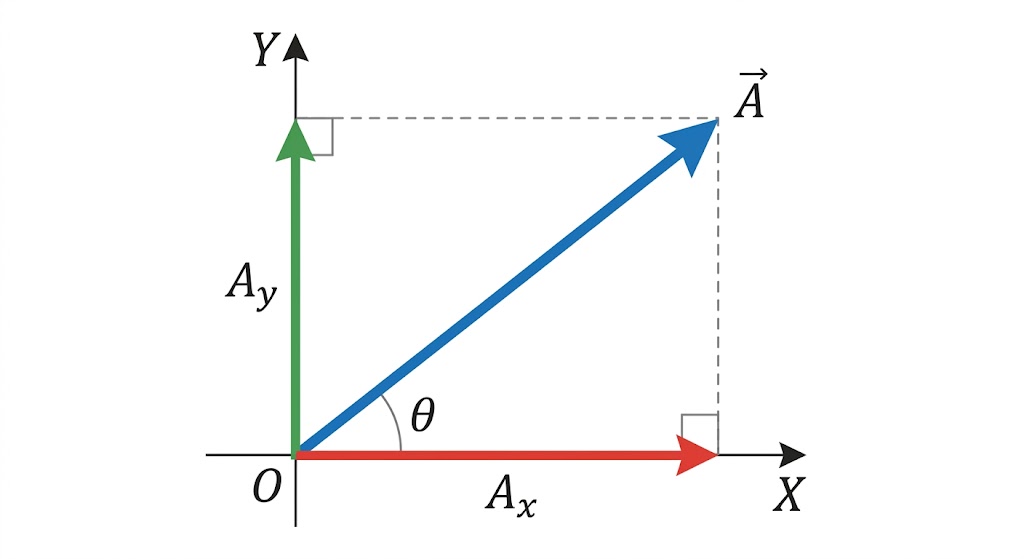 Resolution of Vectors into Components
Resolution is the reverse process of vector addition. It is the process of splitting a single vector into two or more component vectors along given directions (usually perpendicular).
When a vector $\vec{A}$ makes an angle $\theta$ with the positive x-axis:
🎯 Memory trick: "cos" sounds like "close" — the component close to the angle uses cosine. The component perpendicular (far) uses sine!
A unit vector is a vector that has a magnitude of exactly 1 (unity). It is used to specify direction only.
.jpg) Standard Unit Vectors (3D Coordinate System)
Standard Unit Vectors (3D Coordinate System)
Each has magnitude = 1 and they are mutually perpendicular to each other.
If $\vec{A} = 3\hat{i} + 4\hat{j}$, find the magnitude and unit vector.
Solution:
Magnitude: $|\vec{A}| = \sqrt{3^2 + 4^2} = \sqrt{9 + 16} = \sqrt{25} = \mathbf{5\text{ units}}$
Unit vector: $\hat{A} = \frac{\vec{A}}{|\vec{A}|} = \frac{3\hat{i} + 4\hat{j}}{5} = \mathbf{0.6\hat{i} + 0.8\hat{j}}$
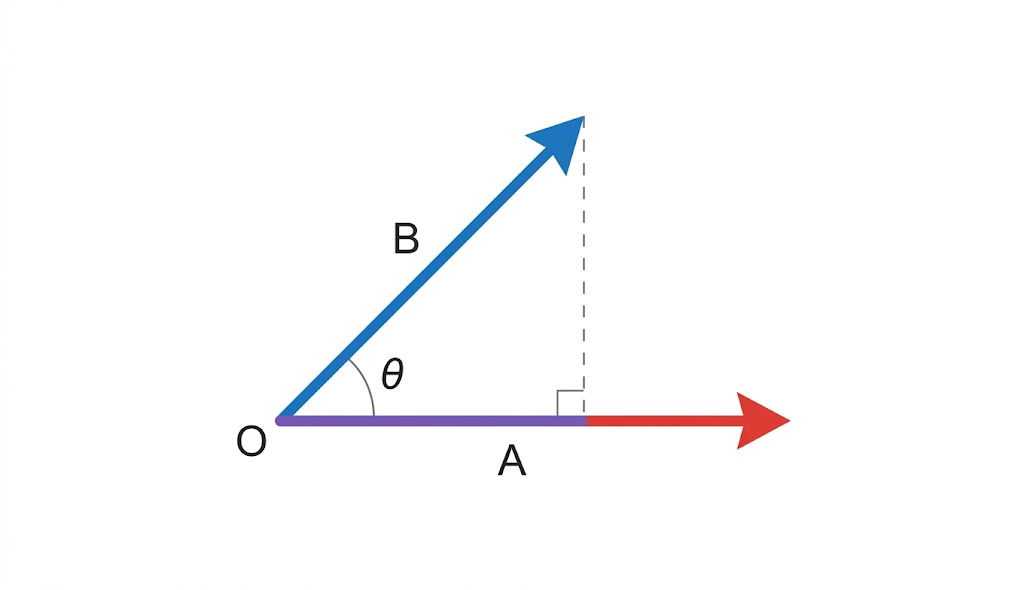 Dot Product Visualization
The dot product of two vectors is a scalar quantity. It is called scalar product because the result is a scalar, not a vector.
The dot product of two vectors $\vec{A}$ and $\vec{B}$ is defined as the product of their magnitudes and the cosine of the angle between them.
Same unit vectors: $\hat{i} \cdot \hat{i} = \hat{j} \cdot \hat{j} = \hat{k} \cdot \hat{k} = \mathbf{1}$
Different unit vectors: $\hat{i} \cdot \hat{j} = \hat{j} \cdot \hat{k} = \hat{k} \cdot \hat{i} = \mathbf{0}$
⚠️ Condition for Perpendicular Vectors:
If $\vec{A} \cdot \vec{B} = 0$, then $\vec{A} \perp \vec{B}$ (perpendicular)
(Because $\theta = 90^\circ$, so $\cos 90^\circ = 0$)
Check if $\vec{A} = 2\hat{i} + 3\hat{j}$ and $\vec{B} = 3\hat{i} - 2\hat{j}$ are perpendicular.
Solution:
$\vec{A} \cdot \vec{B} = (2)(3) + (3)(-2) = 6 - 6 = \mathbf{0}$
Since $\vec{A} \cdot \vec{B} = 0$, the vectors are perpendicular! ✓
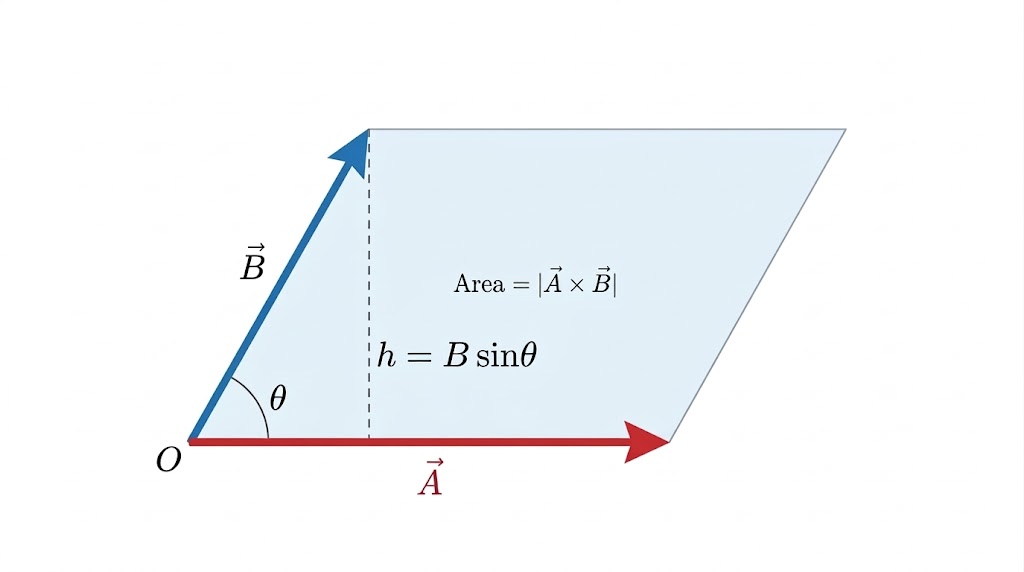 Cross Product - Area of Parallelogram
The cross product of two vectors is a vector quantity. It is called vector product because the result is a vector, not a scalar.
The cross product of two vectors $\vec{A}$ and $\vec{B}$ is a vector perpendicular to both, with magnitude equal to the product of their magnitudes and the sine of the angle between them.
Where $\hat{n}$ is the unit vector perpendicular to both $\vec{A}$ and $\vec{B}$ (found using right-hand rule).
This magnitude equals the area of the parallelogram formed by the two vectors.
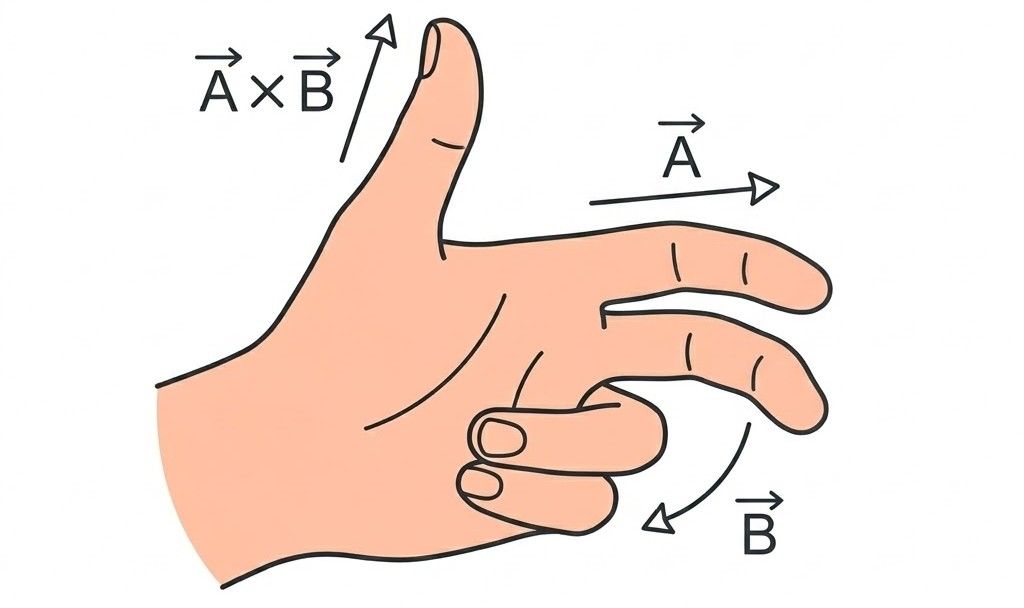 Right-Hand Rule for Cross Product
To find the direction of $\vec{A} \times \vec{B}$:
.jpg) Cyclic Order of Unit Vectors (î, ĵ, k̂)
Cyclic Order of Unit Vectors (î, ĵ, k̂)
Same unit vectors: $\hat{i} \times \hat{i} = \hat{j} \times \hat{j} = \hat{k} \times \hat{k} = \mathbf{0}$
Cyclic order (clockwise):
$\hat{i} \times \hat{j} = \hat{k} \quad | \quad \hat{j} \times \hat{k} = \hat{i} \quad | \quad \hat{k} \times \hat{i} = \hat{j}$
Anti-cyclic order (anti-clockwise):
$\hat{j} \times \hat{i} = -\hat{k} \quad | \quad \hat{k} \times \hat{j} = -\hat{i} \quad | \quad \hat{i} \times \hat{k} = -\hat{j}$
⚠️ Condition for Parallel Vectors:
If $\vec{A} \times \vec{B} = \mathbf{0}$, then $\vec{A} \parallel \vec{B}$ (parallel)
(Because $\theta = 0^\circ$ or $180^\circ$, so $\sin \theta = 0$)
Check if $\vec{A} = 2\hat{i} + 4\hat{j}$ and $\vec{B} = \hat{i} + 2\hat{j}$ are parallel.
Solution:
$\vec{A} \times \vec{B} = (2\hat{i} + 4\hat{j}) \times (\hat{i} + 2\hat{j}) = (2)(2) - (4)(1) = \mathbf{0}$
Since $\vec{A} \times \vec{B} = \mathbf{0}$, the vectors are parallel! ✓
(Note: $\vec{A} = 2\vec{B}$, confirming they are parallel)
| Property | Dot Product ($\vec{A} \cdot \vec{B}$) | Cross Product ($\vec{A} \times \vec{B}$) |
|---|---|---|
| Result Type | Scalar (number) | Vector |
| Formula | $AB \cos \theta$ | $AB \sin \theta \cdot \hat{n}$ |
| Commutativity | Commutative ($\vec{A} \cdot \vec{B} = \vec{B} \cdot \vec{A}$) | Anti-commutative ($\vec{A} \times \vec{B} = -\vec{B} \times \vec{A}$) |
| When $\theta = 0^\circ$ | Maximum ($AB$) | Zero ($\mathbf{0}$) |
| When $\theta = 90^\circ$ | Zero ($0$) | Maximum ($AB$) |
| Physical Examples | Work, Power | Torque, Angular Momentum |
| Zero Condition | Vectors are Perpendicular ($\perp$) | Vectors are Parallel ($\parallel$) |
Vector Addition (Parallelogram Law):
$|\vec{R}| = \sqrt{A^2 + B^2 + 2AB \cos \theta} \quad | \quad \tan \alpha = \frac{B \sin \theta}{A + B \cos \theta}$
Resolution of Vectors:
$A_x = A \cos \theta \quad | \quad A_y = A \sin \theta \quad | \quad A = \sqrt{A_x^2 + A_y^2}$
Unit Vector:
$\hat{A} = \frac{\vec{A}}{|\vec{A}|}$
Dot Product:
$\vec{A} \cdot \vec{B} = AB \cos \theta = A_x B_x + A_y B_y + A_z B_z \quad | \quad \text{If } \vec{A} \cdot \vec{B} = 0 \to \vec{A} \perp \vec{B}$
Cross Product:
$|\vec{A} \times \vec{B}| = AB \sin \theta \quad | \quad \text{If } \vec{A} \times \vec{B} = \mathbf{0} \to \vec{A} \parallel \vec{B}$
🎯 cos is for DOT (same direction component)
🎯 sin is for CROSS (perpendicular component)
🎯 Dot product = 0 → Perpendicular
🎯 Cross product = $\mathbf{0}$ → Parallel