Vardaan Learning Institute
Class 11 Physics • Chapter Notes
🌐 vardaanlearning.com📞 9508841336
Module 6: Gravitation
Dear Class 12 Student! Pay very close attention. Gravitation is the absolute mirror image of Class 12 Electrostatics. In gravitation, masses attract each other. In electrostatics, charges attract or repel each other. The formulas are structurally identical! If you understand gravitational force, fields, and potential energy now, you will automatically know 50% of the first chapter of Class 12 Physics. Let's build that foundation!
1. Newton's Universal Law of Gravitation
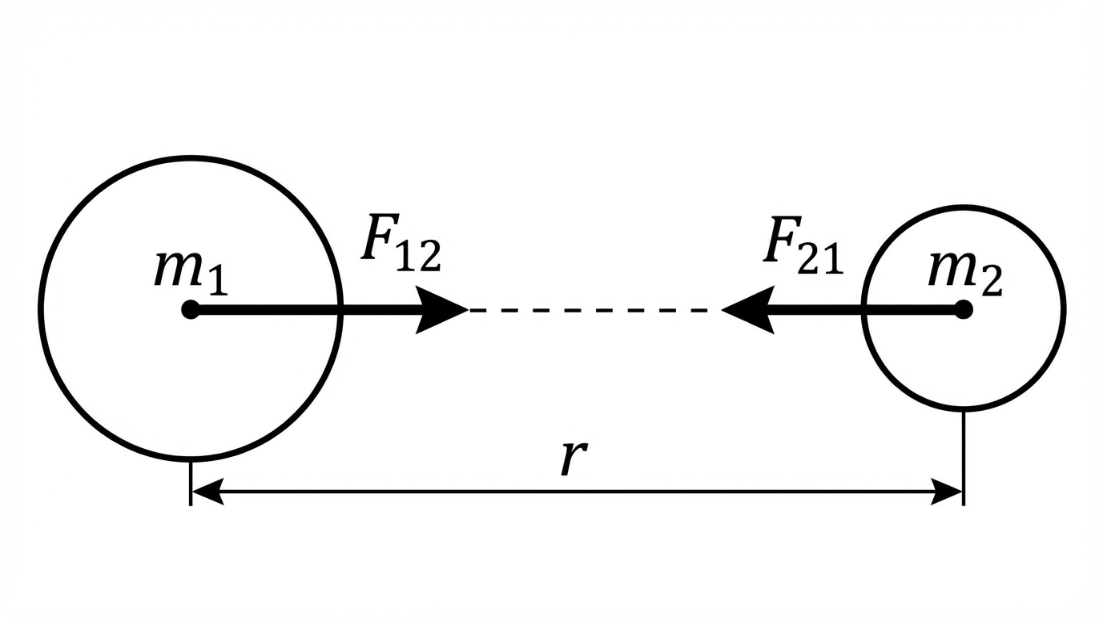
Every particle of matter in the universe attracts every other particle with a force that is directly proportional to the product of their masses and inversely proportional to the square of the distance between their centers.
Concept
Formula for Gravitational Force ($F$):
$$F = G \frac{m_1 m_2}{r^2}$$
- $m_1, m_2$: Masses of the two interacting bodies.
- $r$: The distance between their centers.
- $G$: The Universal Gravitational Constant ($6.67 \times 10^{-11} \text{ N}\cdot\text{m}^2/\text{kg}^2$).
Class 12 Preview: In Electrostatics, you will learn Coulomb's Law: $F = k \frac{q_1 q_2}{r^2}$. Notice the exact same inverse-square structure!
Fact
Key Properties of Gravitational Force:
1. It is always attractive (unlike electrostatic forces, which can repel).
2. It is an action-reaction pair (Newton's 3rd Law). The earth pulls the apple with $1 \text{ N}$, and the apple pulls the earth with exactly $1 \text{ N}$.
3. It is a Central Force (it acts along the line joining the centers of the two bodies).
Practice Problem 1
Question: Two massive lead spheres, each of mass $10,000 \text{ kg}$, are placed with their centers $5.0 \text{ m}$ apart. Calculate the gravitational force of attraction between them.
Solution:
Given: $m_1 = m_2 = 10^4 \text{ kg}$, $r = 5.0 \text{ m}$, $G = 6.67 \times 10^{-11} \text{ N}\cdot\text{m}^2/\text{kg}^2$
$F = G \frac{m_1 m_2}{r^2}$
$F = \frac{(6.67 \times 10^{-11}) \times (10^4) \times (10^4)}{5^2}$
$F = \frac{6.67 \times 10^{-11} \times 10^8}{25}$
$F = \frac{6.67 \times 10^{-3}}{25} = \mathbf{2.668 \times 10^{-4} \text{ N}}$
(Notice how weak this force is compared to everyday forces, which is why we don't feel the gravitational pull of objects around us, only huge planets!)
2. Acceleration due to Gravity ($g$)
When a body falls freely towards the earth, it accelerates. This acceleration produced by the gravitational force of the earth is called acceleration due to gravity, denoted by $g$.
Derivation: Let the mass of the earth be $M$, its radius be $R$, and a small object of mass $m$ be on its surface.
Force by Newton's Law: $F = \frac{G M m}{R^2}$
Force by Newton's 2nd Law: $F = mg$
Equating both: $mg = \frac{G M m}{R^2} \implies$
Formula
$$g = \frac{GM}{R^2}$$
Important Trap
Do not confuse $G$ and $g$!
$G$ is the Universal Gravitational Constant. It is the same everywhere in the universe.
$g$ is the Acceleration due to gravity. It changes depending on which planet you are on, your altitude above the planet, and your depth below the surface. Notice that $g$ is independent of the mass ($m$) of the falling object. A feather and a hammer fall at the same rate in a vacuum!
Practice Problem 2
Question: The mass of a hypothetical planet is 4 times the mass of Earth, and its radius is twice the radius of Earth. If $g = 9.8 \text{ m/s}^2$ on Earth, what is the acceleration due to gravity on this new planet?
Solution:
Let Earth's mass be $M$ and radius be $R$. So, $g_{earth} = \frac{GM}{R^2} = 9.8$
For the new planet: $M_p = 4M$ and $R_p = 2R$
$g_{planet} = \frac{G(4M)}{(2R)^2} = \frac{G(4M)}{4R^2} = \frac{GM}{R^2}$
$g_{planet} = g_{earth} = \mathbf{9.8 \text{ m/s}^2}$
The increased mass and increased radius cancel each other out!
3. Concept of Gravitational Field
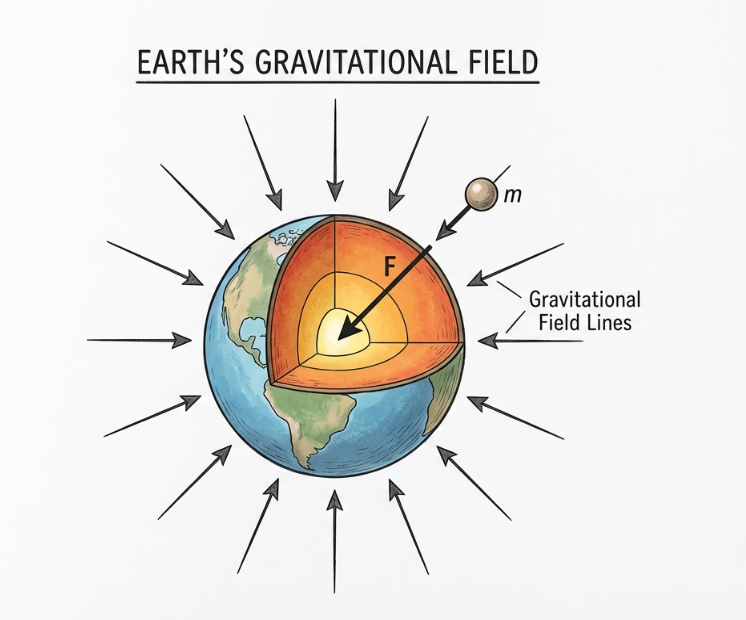
How does the Earth pull the Moon from hundreds of thousands of kilometers away without touching it? The concept of a "Field" answers this. A mass modifies the space around it, creating a "Gravitational Field." When another mass enters this modified space, it experiences a force.
Concept
Gravitational Field Intensity ($E$ or $I$): The force experienced by a unit mass ($1 \text{ kg}$) placed at that point.
$$\vec{E} = \frac{\vec{F}}{m} = \frac{GM}{r^2} \hat{r}$$
Class 12 Preview: In Chapter 1, you will learn about the Electric Field ($\vec{E}$), defined as Force per unit charge ($\vec{E} = \vec{F}/q$). The concept is exactly the same!
4. Gravitational Potential Energy (Basic Concept)
In the previous module, we used $U = mgh$. However, that formula only works near the surface of the earth where $g$ is constant. For objects far away in space (like satellites), $g$ changes, so we need a universal formula.
Definition: The gravitational potential energy of a body at a point is defined as the amount of work done in bringing the given body from infinity to that point against the gravitational force.
Formula
Gravitational Potential Energy ($U$):
$$U = - \frac{G m_1 m_2}{r}$$
Class 12 Preview: The Electrostatic Potential Energy of two charges is $U = k \frac{q_1 q_2}{r}$. The mathematical form is identical, minus the built-in negative sign.
Why is it Negative?
At infinite distance ($r = \infty$), the potential energy is zero ($U = 0$). Since gravity is an attractive force, the system does the work as the masses come closer together, meaning the energy decreases from zero. Thus, it becomes negative. A negative potential energy means it is a bound system (like the Earth bound to the Sun). To break the system apart and send the mass to infinity, you must supply positive energy!
Practice Problem 3
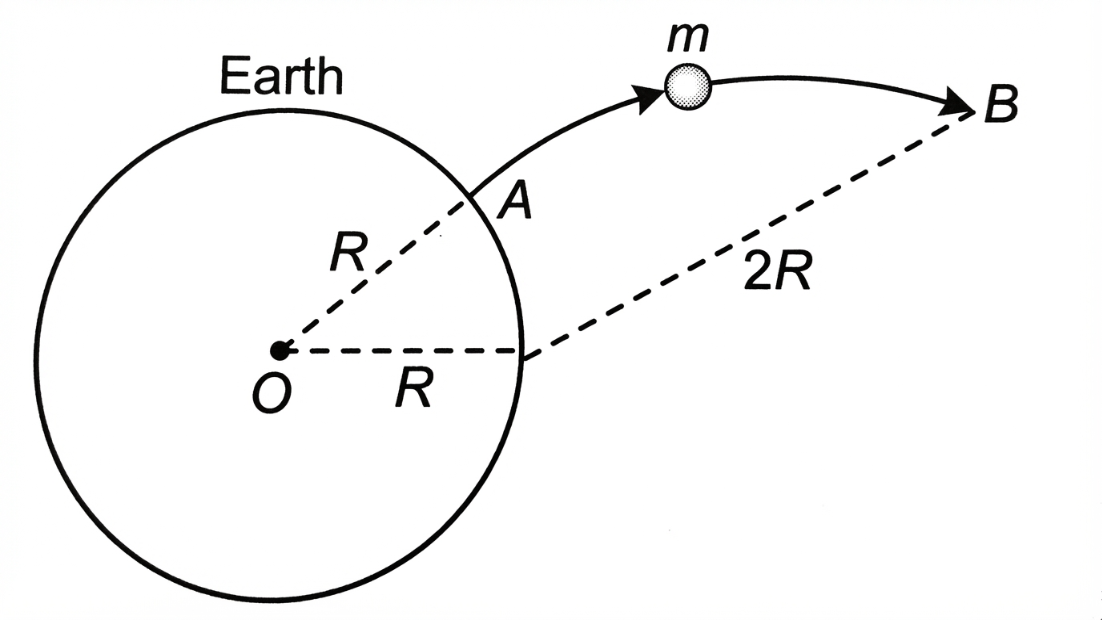
Question: Calculate the change in gravitational potential energy when a body of mass $m$ is raised to a height equal to the radius of the Earth ($h=R$) from the surface of the Earth. (Mass of Earth = $M$, Radius = $R$).
Solution:
Initial Potential Energy (at surface, distance from center = $R$):
$U_i = -\frac{GMm}{R}$
Final Potential Energy (at height $h=R$, total distance from center = $R+R = 2R$):
$U_f = -\frac{GMm}{2R}$
Change in PE ($\Delta U$) = $U_f - U_i$
$\Delta U = \left( -\frac{GMm}{2R} \right) - \left( -\frac{GMm}{R} \right)$
$\Delta U = \frac{GMm}{R} - \frac{GMm}{2R} = \mathbf{+\frac{GMm}{2R}}$
Advanced Note: Since $g = \frac{GM}{R^2}$, we can write $GM = gR^2$. Substituting this in, $\Delta U = \frac{(gR^2)m}{2R} = \frac{1}{2}mgR$. Notice this is NOT simply $mgh$ ($mgR$) because $g$ decreased as it went up!