
CBSE Class 11 Physics • Chapter 14 • Detailed Notes
Chapter Overview
This chapter covers the detailed physics of Wave Motion, including mechanical waves, equation of progressive waves, reflection, superposition, standing waves, beats, and the Doppler effect.
Wave Motion: It is a mode of energy transfer from one point to another without the permanent transport of matter. Patterns of disturbance move through the medium.
Mechanism: Particles of the medium oscillate about their mean positions. The disturbance is handed over from one particle to the next due to Elasticity and Inertia of the medium.
Types of Waves based on Medium:
Comparison based on particle vibration direction relative to wave propagation.
| Property | Transverse Wave | Longitudinal Wave |
|---|---|---|
| Particle Vibrations | Perpendicular ($\perp$) to wave propagation. | Parallel ($\parallel$) to wave propagation. |
| Formation | Travels in the form of Crests (Pos. Max) and Troughs (Neg. Max). | Travels in the form of Compressions (High Density) and Rarefactions (Low Density). |
| Medium Required | Requires Rigidity (Shear modulus). Solids and Surface of Liquids. | Requires Elasticity of Volume (Bulk modulus). Solids, Liquids, and Gases. |
| Pressure Variation | No pressure variation in the medium. | Pressure and density vary at every point. |
| Polarization | Can be polarized. | Cannot be polarized. |
Derivation of the Equation of a Plane Progressive Harmonic Wave:
Goal: To mathematically describe a wave where every particle performs Simple Harmonic Motion (SHM).
Step 1: Motion at the Source ($x=0$)
Assume the particle at the origin ($x=0$) oscillates in SHM starting from mean position:
$$ y(0, t) = A \sin(\omega t) $$
Step 2: Propagation & Time Lag
The disturbance travels with wave velocity $v$. To reach a particle at position $x$, the wave takes time $t_{lag} = \frac{x}{v}$.
Step 3: Motion at Position $x$
The particle at $x$ does exactly what the source particle did earlier at time $(t - t_{lag})$.
$$ y(x, t) = y(0, t - t_{lag}) $$
Substituting the SHM equation:
$$ y(x, t) = A \sin[\omega (t - \frac{x}{v})] $$
$$ y(x, t) = A \sin(\omega t - \frac{\omega}{v}x) $$
Step 4: Defining Wave Constants
We define Propagation Constant (or Angular Wave Number) as $k = \frac{\omega}{v} = \frac{2\pi \nu}{\nu \lambda} = \frac{2\pi}{\lambda}$.
Substituting $k$:
$$ y(x, t) = A \sin(\omega t - kx) $$
Note: Since $\sin(-\theta) = -\sin(\theta)$, and usually we start with $kx$, we often write it as:
This represents a wave traveling in the Positive X direction.
Why $(kx - \omega t)$?
General Sinusoidal Wave Equation:
$$ y(x, t) = A \sin(kx - \omega t + \phi) $$Detailed Analysis of Terms:
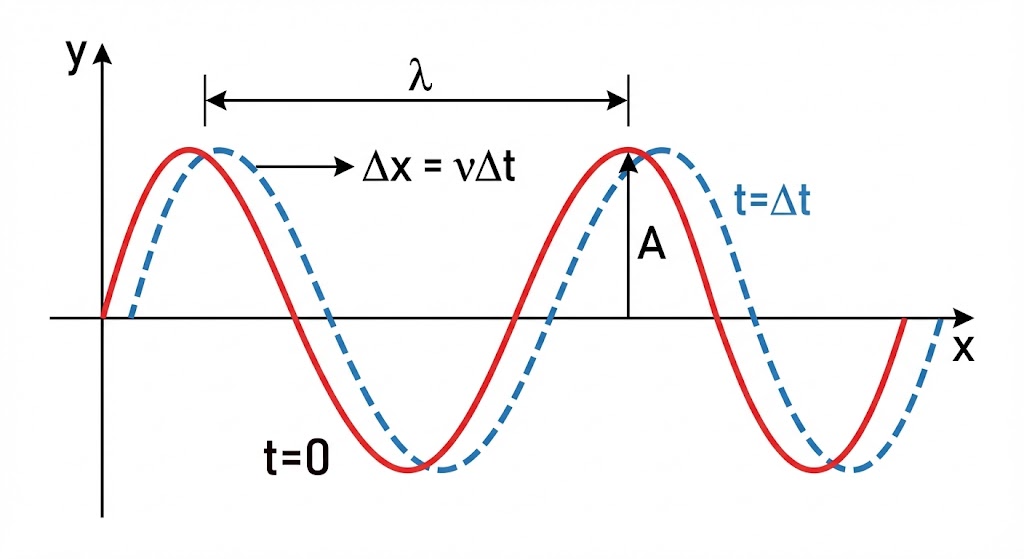
Relation between Phase Diff ($\Delta \phi$), Path Diff ($\Delta x$), and Time Diff ($\Delta t$):
1. Phase difference for two particles separated by distance $\Delta x$:
We know: $\lambda \longleftrightarrow 2\pi$
This means phase per unit length is: $\frac{2\pi}{\lambda}$
So if distance is $\Delta x$, phase difference will be: $\Delta \phi = \frac{2\pi}{\lambda} \times \Delta x$
This gives:
2. Phase difference for the SAME particle after time interval $\Delta t$:
We know: $T \longleftrightarrow 2\pi$
This means phase per unit time is: $\frac{2\pi}{T}$
So if time interval is $\Delta t$, phase difference will be: $\Delta \phi = \frac{2\pi}{T} \times \Delta t$
This gives:
Q: A wave equation is $y = 0.05 \sin(80x - 3t)$. Find velocity and wavelength. (SI units)
Solution: Compare with standard $y = A \sin(kx - \omega t)$.
Wave velocity depends ONLY on the properties of the medium (Elasticity $E$ and Inertia $\rho$).
$$ v = \sqrt{\frac{E}{\rho}} $$Goal: To derive $v = \sqrt{T/\mu}$ using the concept of Centripetal Force.
Logic: Imagine moving with the pulse at speed $v$. In this frame, the pulse appears stationary, and the string moves backward with speed $v$.
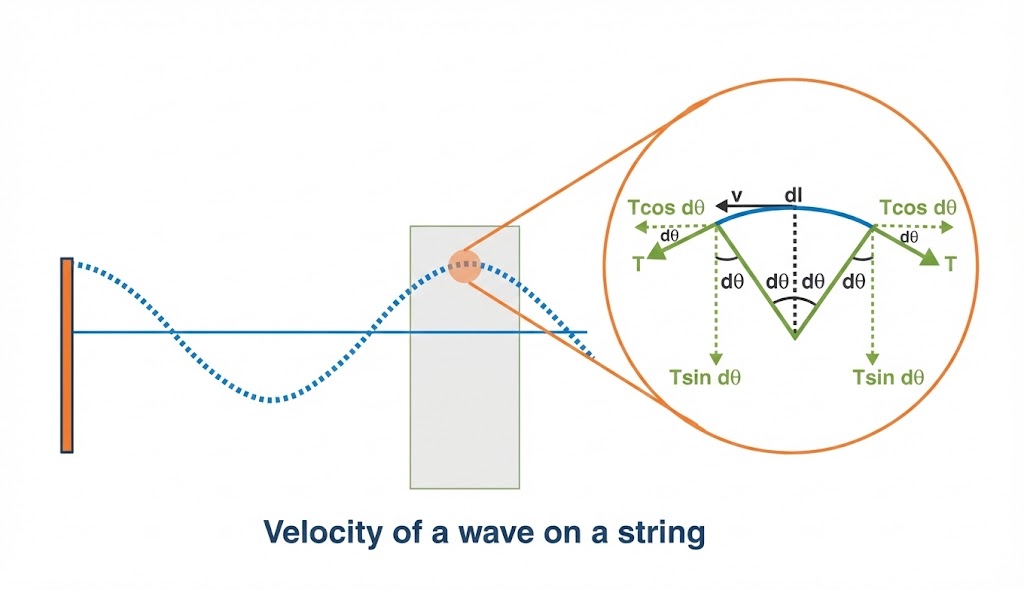
Step 1: Dynamics of Element
Consider a small element of length $dl = R(2\theta)$ (where $\theta$ is small half-angle). Mass $dm = \mu (2R\theta)$.
The element moves on a curved path of radius $R$ with speed $v$. Required Centripetal Force:
$$ F_c = \frac{(dm)v^2}{R} = \frac{(2\mu R \theta)v^2}{R} = 2\mu v^2 \theta $$
Step 2: Restoring Force
The tension $T$ at both ends provides the downward radial force. Vertical component is $2T \sin\theta$.
For small $\theta$, $\sin\theta \approx \theta$. So, $F_{res} \approx 2T\theta$.
Step 3: Equating Forces
$$ 2T\theta = 2\mu v^2 \theta $$
$$ T = \mu v^2 \Rightarrow v = \sqrt{\frac{T}{\mu}} $$
General Formula: $v = \sqrt{\frac{B}{\rho}}$ where $B$ is Bulk Modulus.
Definition of Bulk Modulus: $B = -V \frac{dP}{dV}$.
1. Newton's Formula (Isothermal):
Assumption: Sound travels slowly, temperature remains constant ($PV = \text{constant}$).
Differentiating: $P dV + V dP = 0 \Rightarrow P dV = -V dP \Rightarrow P = -V \frac{dP}{dV}$.
This implies $B_{iso} = P$. So, $v = \sqrt{\frac{P}{\rho}}$.
(Result: ~280 m/s for air. Incorrect.)
2. Laplace's Correction (Adiabatic):
Assumption: Compressions are rapid, heat cannot escape ($PV^\gamma = \text{constant}$).
Differentiating: $\gamma P V^{\gamma-1} dV + V^\gamma dP = 0$.
Divide by $V^{\gamma-1}$: $\gamma P dV + V dP = 0 \Rightarrow \gamma P = -V \frac{dP}{dV}$.
This implies $B_{adia} = \gamma P$. So, $v = \sqrt{\frac{\gamma P}{\rho}}$.
(Result: ~331 m/s. Correct!)
Factors Affecting Speed of Sound in Gas:
Principle of Superposition: When two or more waves simultaneously pass through a point in a medium, the resultant displacement at that point is the vector sum of the displacements produced by the individual waves.
$$ \vec{y} = \vec{y}_1 + \vec{y}_2 + \dots + \vec{y}_n $$Analytical Treatment of Interference:
Consider two harmonic waves of the same frequency and amplitude, travelling in the same direction, with a constant phase difference $\phi$:
$$ y_1 = A \sin(kx - \omega t) $$
$$ y_2 = A \sin(kx - \omega t + \phi) $$
By Principle of Superposition, the resultant displacement $y = y_1 + y_2$ is:
$$ y = A [\sin(kx - \omega t) + \sin(kx - \omega t + \phi)] $$
Using the trigonometric identity $\sin C + \sin D = 2 \sin\left(\frac{C+D}{2}\right) \cos\left(\frac{C-D}{2}\right)$:
The resultant wave is also a harmonic wave with:
Types of Interference:
1. Constructive Interference:
When waves meet in the same phase, their amplitudes add up to give maximum intensity.
2. Destructive Interference:
When waves meet in opposite phases, their amplitudes cancel out to give minimum intensity.
Transverse Wave Superposition
Superposition Scenario 1
Superposition Scenario 2
Superposition Scenario 3
Boundary Conditions:
Reflection at Fixed End (Phase Inversion)
Reflection at Free End (No Phase Change)
Goal: To show that superposition of two identical counter-propagating waves creates a stationary wave pattern.
1. Wave Equations:
Incident Wave ($+x$): $y_1 = A \sin(kx - \omega t)$
Reflected Wave ($-x$): $y_2 = A \sin(kx + \omega t)$ (Assuming reflection from free end/ open pipe for in-phase reflection).
2. Superposition Principle:
$$ y = y_1 + y_2 = A [\sin(kx - \omega t) + \sin(kx + \omega t)] $$
Using Identity: $\sin(C) + \sin(D) = 2 \sin(\frac{C+D}{2}) \cos(\frac{C-D}{2})$
3. Interpretation:
4. Nodes and Antinodes:
Nodes (Zero Displacement):
$\sin(kx) = 0 \Rightarrow kx = n\pi$
$\frac{2\pi}{\lambda} x = n\pi \Rightarrow x = \frac{n\lambda}{2}$
Positions: $x = 0, \frac{\lambda}{2}, \lambda, \frac{3\lambda}{2} \dots$
Antinodes (Max Displacement $\pm 2A$):
$\sin(kx) = \pm 1 \Rightarrow kx = (2n+1)\frac{\pi}{2}$
Positions: $x = \frac{\lambda}{4}, \frac{3\lambda}{4}, \frac{5\lambda}{4} \dots$
A string of length $L$ fixed at both ends can only vibrate in modes where the string length is an integer multiple of half-wavelengths: $L = \frac{n\lambda}{2}$.
So, $\lambda_n = \frac{2L}{n}$ and wave speed $v = \sqrt{T/\mu}$. The allowed frequencies are:
Fundamental / 1st Harmonic
2nd Harmonic
3rd Harmonic
| Mode (n) | Name | Nodes | Antinodes | Wavelength | Frequency |
|---|---|---|---|---|---|
| 1 | Fundamental / 1st Harmonic | 2 | 1 | $\lambda_1 = 2L$ | $\nu_1 = \frac{v}{2L}$ |
| 2 | 2nd Harmonic / 1st Overtone | 3 | 2 | $\lambda_2 = L$ | $\nu_2 = \frac{v}{L} = 2\nu_1$ |
| 3 | 3rd Harmonic / 2nd Overtone | 4 | 3 | $\lambda_3 = \frac{2L}{3}$ | $\nu_3 = \frac{3v}{2L} = 3\nu_1$ |
| $n$ | $n$-th Harmonic | $n+1$ | $n$ | $\lambda_n = \frac{2L}{n}$ | $\nu_n = n\nu_1$ |
Key Point: A stretched string (both ends fixed) supports ALL harmonics (both odd and even multiples of $\nu_1$). This is why stringed instruments like the sitar or violin produce a rich musical tone.
Closed end → always a Node (N). Open end → always an Antinode (A).
Condition: $L = (2n-1)\frac{\lambda}{4}$, giving allowed frequencies:
Fundamental
3rd Harmonic
5th Harmonic
| Mode (n) | Name | Frequency | Harmonic Number |
|---|---|---|---|
| 1 | Fundamental | $\nu_1 = \frac{v}{4L}$ | 1st harmonic |
| 2 | 1st Overtone | $\nu_2 = \frac{3v}{4L} = 3\nu_1$ | 3rd harmonic |
| 3 | 2nd Overtone | $\nu_3 = \frac{5v}{4L} = 5\nu_1$ | 5th harmonic |
| $n$ | $(n-1)$th Overtone | $\nu_n = (2n-1)\frac{v}{4L}$ | $(2n-1)$th harmonic |
Key Point: A closed pipe supports only ODD harmonics ($\nu_1, 3\nu_1, 5\nu_1\ldots$). This gives a hollow, nasal sound.
Both open ends → always Antinodes (A) at both ends.
Condition: $L = \frac{n\lambda}{2}$, giving allowed frequencies:
Fundamental
2nd Harmonic
3rd Harmonic
| Mode (n) | Name | Frequency | Harmonic Number |
|---|---|---|---|
| 1 | Fundamental | $\nu_1 = \frac{v}{2L}$ | 1st harmonic |
| 2 | 1st Overtone | $\nu_2 = \frac{v}{L} = 2\nu_1$ | 2nd harmonic |
| 3 | 2nd Overtone | $\nu_3 = \frac{3v}{2L} = 3\nu_1$ | 3rd harmonic |
| $n$ | $(n-1)$th Overtone | $\nu_n = \frac{nv}{2L}$ | $n$th harmonic |
Key Point: An open pipe supports ALL harmonics. Its fundamental frequency is twice that of a closed pipe of the same length ($\nu_{open} = 2\nu_{closed}$).
Resonance is the phenomenon in which a body vibrates with maximum amplitude when the frequency of an applied periodic force equals the body's own natural frequency.
📷 AI Image Generation Prompt (Resonance Column Experiment): A highly detailed, realistic 3D educational diagram of a resonance column apparatus. It shows a tall cylindrical glass tube filled with water, with a flexible rubber pipe connecting the bottom of the tube to a water reservoir. A vibrating silver tuning fork is held just above the open top end of the glass tube. Inside the tube, sound waves are illustrated bouncing down to the water surface and reflecting back. A ruler scale is firmly attached to the glass tube to measure the air column length $L$. Annotations point to the "Tuning Fork", "Air Column (Node at water, Antinode at open end)", and "Water Level". Clear, professional lighting with a pale neutral background.
End Correction ($e$):
The antinode in an open pipe is not formed exactly at the open end but slightly outside it.
Formula: $e = 0.6r$ (where $r$ is radius of pipe).
Corrected effective lengths:
Goal: Deriving the Beat Frequency ($\nu_b = \nu_1 - \nu_2$) from superposition.
Consider two sound waves at $x=0$ with slightly different frequencies $\omega_1$ and $\omega_2$:
$$ y_1 = A \cos(\omega_1 t) \quad , \quad y_2 = A \cos(\omega_2 t) $$
Superposition: $y = y_1 + y_2 = A [\cos(\omega_1 t) + \cos(\omega_2 t)]$
Using $\cos C + \cos D = 2 \cos(\frac{C-D}{2}) \cos(\frac{C+D}{2})$:
Let $\omega_{avg} = \frac{\omega_1 + \omega_2}{2}$ and $\Delta \omega = \frac{\omega_1 - \omega_2}{2}$.
Interpretation: This is a wave with frequency $\nu_{avg}$ but its amplitude varies with time.
Amplitude Modulation: $A(t) = 2A \cos(2\pi \frac{\nu_1-\nu_2}{2} t)$.
Maxima (Waxing): Amplitude is max when $\cos(\dots) = \pm 1$.
Arguments: $0, \pi, 2\pi \dots$
Time interval between two maxima: $\Delta t = \frac{1}{|\nu_1 - \nu_2|}$.
Therefore, Frequency of Beats:
The apparent change in frequency of wave due to the relative motion between Source (S), Observer (O), and Medium.
Derivation using Wave Crest Counting Logic:
Let Source ($S$) emit frequency $\nu_0$ and move with velocity $v_s$. Observer ($O$) moves with $v_o$. Speed of sound is $v$.
1. Effect of Source Motion (Change in Wavelength):
In time $t=1$ sec, Source emits $\nu_0$ waves. These waves occupy distance $(v - v_s)$ if Source moves towards observer.
New Wavelength $\lambda' = \frac{\text{Distance}}{\text{Number}} = \frac{v - v_s}{\nu_0}$.
2. Effect of Observer Motion (Change in Relative Velocity):
Observer moves towards incoming waves. Relative velocity of wave w.r.t Observer is $v_{rel} = v + v_o$.
3. Apparent Frequency:
$$ \nu' = \frac{\text{Relative Speed}}{\text{Effective Wavelength}} = \frac{v + v_o}{\lambda'} $$
Substituting $\lambda'$:
$$ \nu' = (v + v_o) \cdot \frac{\nu_0}{v - v_s} $$
Sign Convention (Top Signs): Use Top signs ($+v_o, -v_s$) when approaching each other. Use Bottom signs when receding.
| Situation | Condition | Formula | Effect on $\nu'$ |
|---|---|---|---|
| Source moves towards stationary observer | $v_o = 0$, $v_s > 0$ (towards O) | $\nu' = \nu_0 \left(\frac{v}{v - v_s}\right)$ | Increases (Higher pitch) |
| Source moves away from stationary observer | $v_o = 0$, $v_s > 0$ (away from O) | $\nu' = \nu_0 \left(\frac{v}{v + v_s}\right)$ | Decreases (Lower pitch) |
| Observer moves towards stationary source | $v_s = 0$, $v_o > 0$ (towards S) | $\nu' = \nu_0 \left(\frac{v + v_o}{v}\right)$ | Increases (Higher pitch) |
| Observer moves away from stationary source | $v_s = 0$, $v_o > 0$ (away from S) | $\nu' = \nu_0 \left(\frac{v - v_o}{v}\right)$ | Decreases (Lower pitch) |
| Both S and O at rest | $v_s = 0$, $v_o = 0$ | $\nu' = \nu_0$ | No change |
Important note: The Doppler formula applies only when the speeds of source and observer are less than the speed of sound. When a source moves at the speed of sound ($v_s = v$), a shock wave (sonic boom) is produced. The ratio $v_s/v$ is called the Mach Number.
A common daily-life example: The whistle of an approaching train sounds shriller (higher pitch) and that of a receding train sounds graver (lower pitch) — Doppler Effect!
| Quantity | Formula | Symbols |
|---|---|---|
| Progressive Wave | $y(x,t) = A\sin(kx - \omega t + \phi)$ | $A$=amplitude, $k$=wave number, $\omega$=ang. freq., $\phi$=phase const. |
| Wave Number | $k = \frac{2\pi}{\lambda}$ | $\lambda$=wavelength |
| Angular Frequency | $\omega = \frac{2\pi}{T} = 2\pi\nu$ | $T$=period, $\nu$=frequency |
| Wave Speed | $v = \nu\lambda = \frac{\omega}{k}$ | |
| Speed on String | $v = \sqrt{\frac{T}{\mu}}$ | $T$=Tension, $\mu$=linear mass density |
| Speed of Sound (Laplace) | $v = \sqrt{\frac{\gamma P}{\rho}}$ | $\gamma$=$C_p/C_v$, $P$=pressure, $\rho$=density |
| Standing Wave | $y(x,t) = [2A\sin(kx)]\cos(\omega t)$ | Nodes at $x=n\lambda/2$, Antinodes at $x=(2n+1)\lambda/4$ |
| String Harmonics (both ends fixed) | $\nu_n = \frac{nv}{2L}$ | $n=1,2,3\ldots$ (all harmonics) |
| Closed Pipe Harmonics | $\nu_n = \frac{(2n-1)v}{4L}$ | $n=1,2,3\ldots$ (odd harmonics only) |
| Open Pipe Harmonics | $\nu_n = \frac{nv}{2L}$ | $n=1,2,3\ldots$ (all harmonics) |
| Beat Frequency | $\nu_{beat} = |\nu_1 - \nu_2|$ | Valid when $|\nu_1-\nu_2|$ is small |
| Doppler Effect | $\nu' = \nu_0\left(\frac{v \pm v_o}{v \mp v_s}\right)$ | +/− for approaching; −/+ for receding |