Chapter Overview:
In the last two chapters, we learnt about landforms and drainage. This chapter focuses on the third
element of our environment—Climate. We will understand why we wear woollens in December
or why it rains in June and July.
1. Introduction
- Climate: Sum total of weather conditions and variations over a large area for a
long period of time (more than 30 years).
- Weather: State of the atmosphere over an area at any point of time.
- Elements: Temperature, Atmospheric Pressure, Wind, Humidity, and Precipitation.
Note: India has a Monsoon type of climate (derived from Arabic word
'mausim' meaning season). Found mainly in South and Southeast Asia.
2. Climatic Controls
There are six major controls of the climate of any place:
- 1. Latitude: Solar energy varies due to the curvature of earth. Temp decreases from
equator to poles.
- 2. Altitude: Temp decreases as we go higher (Atmosphere becomes less dense). Hills are
cooler in summers.
- 3. Pressure and Wind System: Depends on latitude and altitude. Influences rainfall
patterns.
- 4. Distance from the Sea (Continentality): Sea has a moderating effect. As distance
increases, people experience extreme weather conditions (Very hot summers, very cold winters).
- 5. Ocean Currents: Warm or cold currents affect coastal climate.
- 6. Relief Features: High mountains act as barriers for cold/hot winds or rain-bearing
winds (Orographic rain).
3. Factors Affecting India's Climate
(i) Latitude
The Tropic of Cancer passes through the middle of the country (Rann of Kuchchh to Mizoram).
India has characteristics of both Tropical (South) and Subtropical (North)
climates.
(ii) Altitude
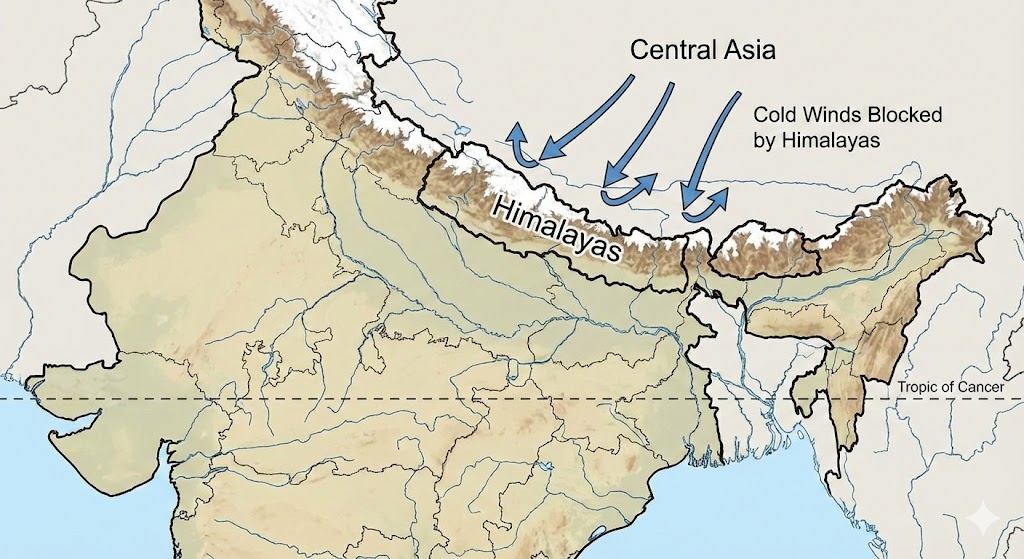
India has mountains to the north (Himalayas - avg height 6000m) which prevent cold winds from Central Asia
from entering the subcontinent. This ensures milder winters compared to Central Asia.
(iii) Pressure and Winds
India's climate is governed by:
- Surface Winds: Northeast trade winds blow from land to sea (Dry). In summer, a
low-pressure area develops over interior Asia and NW India, reversing wind direction. Winds blow from
Indian Ocean (High Pressure) to Land (Low Pressure) carrying moisture = Southwest Monsoon
Winds.
- Upper Air Circulation (Jet Streams): Fast flowing currents in a narrow zone in the
upper atmosphere.
- Westerly Jet Stream: Flows south of Himalayas in winter.
- Easterly Jet Stream: Flows over Peninsular India (14°N) in summer.
- Western Cyclonic Disturbances: Winter rains in north/north-west brought by westerly
flow from the Mediterranean region.
4. The Indian Monsoon
Mechanism of Monsoon:
- Differential Heating/Cooling: Land gets hotter/cooler faster than water. Low
pressure on land (summer), High pressure on sea.
- ITCZ Shift: Inter Tropical Convergence Zone shifts over Ganga plain in Summer
(Monsoon Trough).
- Madagascar High: High pressure east of Madagascar pushes winds towards India.
- Tibetan Plateau: Gets intensely heated, vertical air currents form.
- El Nino (ENSO): Periodic warm ocean current off the coast of Peru. Affects pressure
conditions. (Negative effect on Monsoon).
Onset and Withdrawal
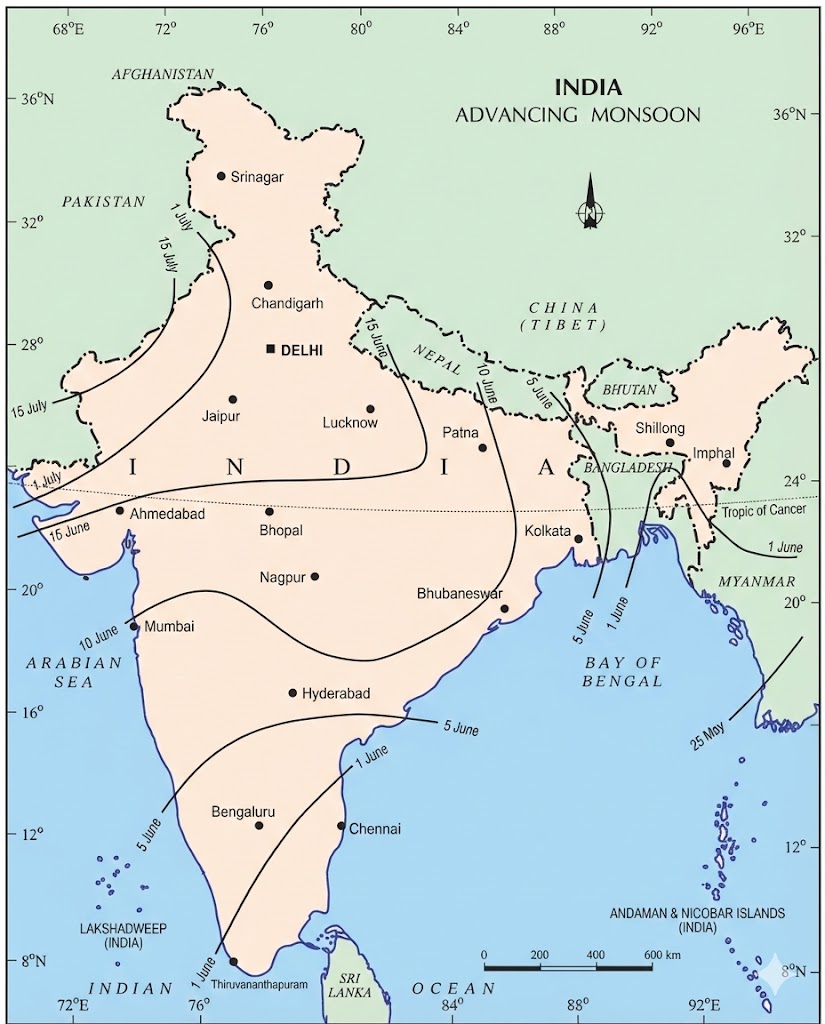
- Onset: Early June (Southern tip). Splits into Arabian Sea branch and Bay of Bengal
branch. Covers entire country by mid-July.
- Burst of Monsoon: Sudden increase in normal rainfall continuing for several days.
- Withdrawal: Begins in early September in NW states. Within mid-October, withdraws
completely from Northern half.
5. The Seasons
Four main seasons can be identified in India:
(i) The Cold Weather Season (Winter)
- Duration: Mid-November to February.
- Features: Days are warm, nights are cold. Frost in North.
- Winds: Northeast Trade winds (Land to Sea = Dry).
- Rainfall: Tamil Nadu coast gets rain (Winds blow Sea to Land). North gets winter rain
(Mahawat) due to Western Disturbances - good for Rabi crops.
(ii) The Hot Weather Season (Summer)
- Duration: March to May.
- Phenomena:
- Loo: Strong, gusty, hot, dry winds blowing during the day.
- Kaal Baisakhi: Dust storms and localized thunderstorms in West Bengal.
- Mango Showers: Pre-monsoon showers in Kerala/Karnataka (help ripening of
mangoes).
(iii) Advancing Monsoon (The Rainy Season)
- Duration: June to September.
- Mechanism: Low pressure over Northern Plains attracts trade winds from Southern
Hemisphere. They cross equator and blow as Southwest Monsoon.
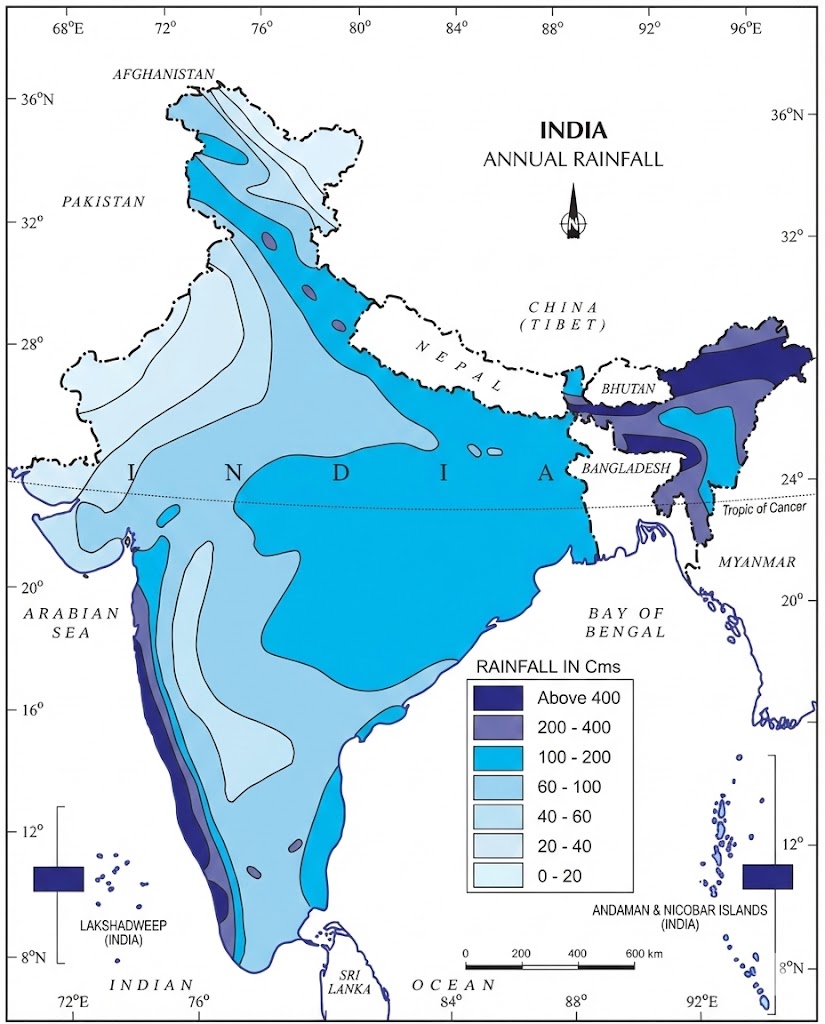
- Distribution: Western Ghats (Windward side) get heavy rain (>250cm). Deccan plateau
(Leeward side) gets less rain. Mawsynram (Meghalaya) gets highest rainfall in existing world.
- Break in Monsoon: Wet and dry spells interspersed.
(iv) Retreating/Post Monsoons (Transition)
- Duration: October-November.
- Features: Clear skies and rise in temperature. Days are oppressive due to heat +
humidity = "October Heat".
- Cyclones: Low pressure transfers to Bay of Bengal, causing cyclones affecting East
Coast (Odisha, Andhra, TN).
6. Distribution of Rainfall
- Heavy Rainfall (>400 cm): Western coast and Northeastern India.
- Scanty Rainfall (<60 cm): Western Rajasthan, parts of Gujarat, Haryana, Punjab,
Interior Deccan plateau, Leh (Ladakh).
- Rest of India: Moderate rainfall.
7. Monsoon as a Unifying Bond
Despite regional variations, the systematic alteration of winds and the rhythmic cycle of seasons bind the
entire country. The Indian landscape, its animal and plant life, its agricultural calendar, and the life of
the people (festivals) revolve around this phenomenon.
Q1: Which winds bring rainfall to the Malabar coast?
Ans: Southwest Monsoon Winds.
Q2: Define 'Loo'.
Ans: Strong, gusty, hot, dry winds blowing during the day over north and northwestern
India during summer.