
In our daily language, the word 'work' is used for some sort of exertion (physical or mental). But in Physics, the term 'work' is used in relation to the displacement produced by a force.
Definition: Work is said to be done only when the force applied on a body makes the body move (i.e., there is a displacement of the body).
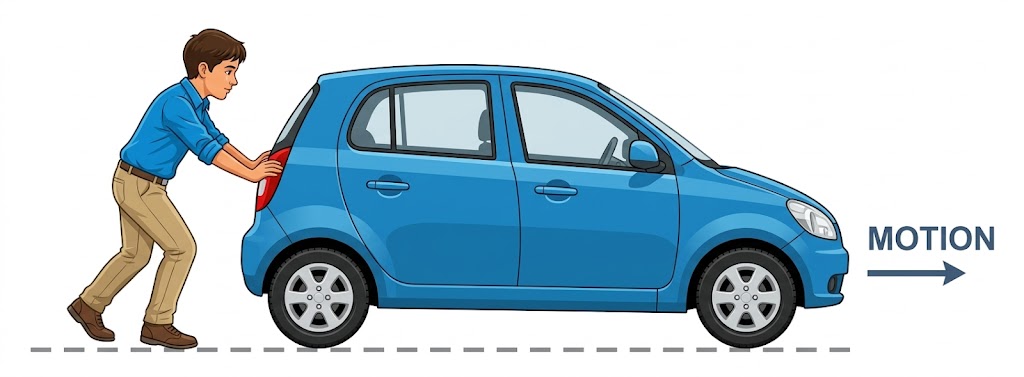
Fig 2.1 A man pushing a car
If there is no displacement of the body even when a force acts on it, the work done is zero. For example, a man trying to push a rigid wall or a coolie holding a load on his head while standing still does no work in the scientific sense.
Q1. When is work said to be done by a force?
Ans: Work is said to be done by a force when the force produces displacement in the body on which it acts.
Q2. A person man holds a block of mass $M$ for 10 minutes. Work done?
Ans: Zero, because there is no displacement of the block.
The amount of work done by a force depends on two factors: (1) magnitude of the force, and (2) displacement of the body.
Where $F$ is force, $S$ is displacement, and $\theta$ is the angle between the force and displacement vectors.
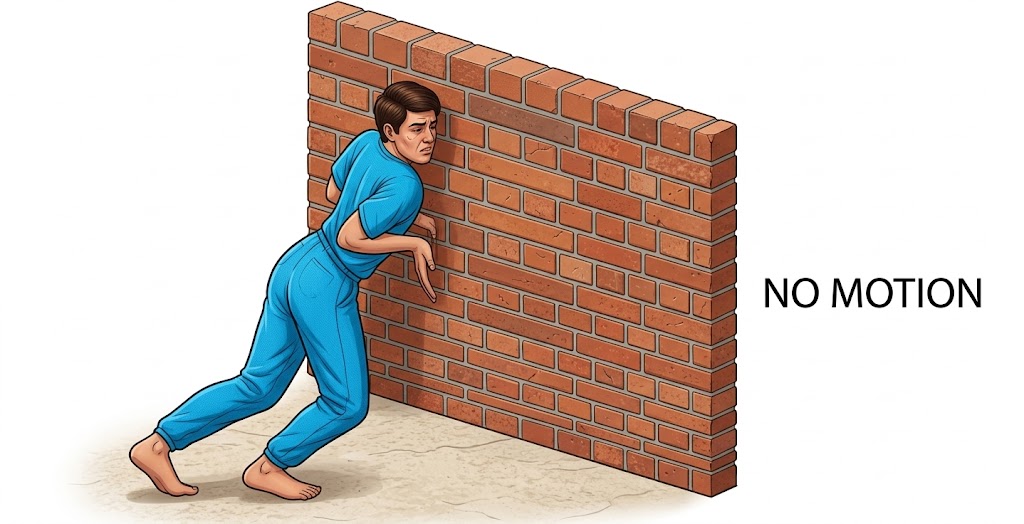
Fig 2.2 Force applied at an angle $\theta$
Note: Work is a scalar quantity (dot product of force and displacement vectors), but it can be positive, negative, or zero depending on the direction of displacement relative to the force.
Case (i): $\theta = 0^\circ$ (Positive Work)
Direction of displacement is same as force. $\cos 0^\circ = 1$.
$W = F \times S$. (Max positive work).
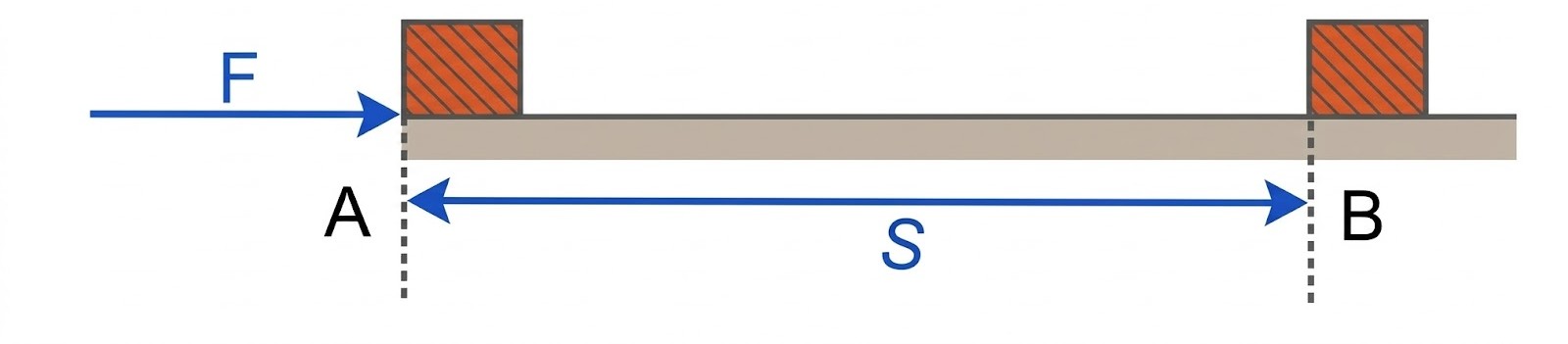
Fig 2.3 Force and displacement in same direction ($\theta = 0^\circ$)
Case (ii): $\theta = 90^\circ$ (Zero Work)
Direction of displacement is perpendicular to force. $\cos 90^\circ = 0$.
$W = 0$. (e.g., Earth moving around Sun, Centripetal force).
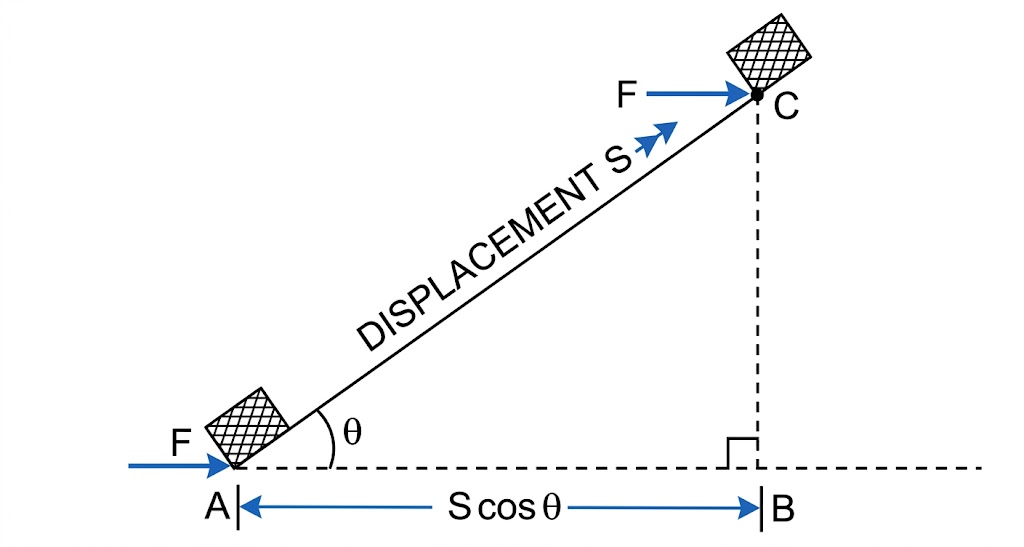
Fig 2.4 Force and displacement at right angles ($\theta = 90^\circ$)
Case (iii): $\theta = 180^\circ$ (Negative Work)
Displacement is opposite to force. $\cos 180^\circ = -1$.
$W = -F \times S$. (e.g., Work done by friction).

Fig 2.5 Force and displacement in opposite direction ($\theta = 180^\circ$)
If the force is not constant, we find the work done from a Force-Displacement Graph. The area under the curve gives the work done.
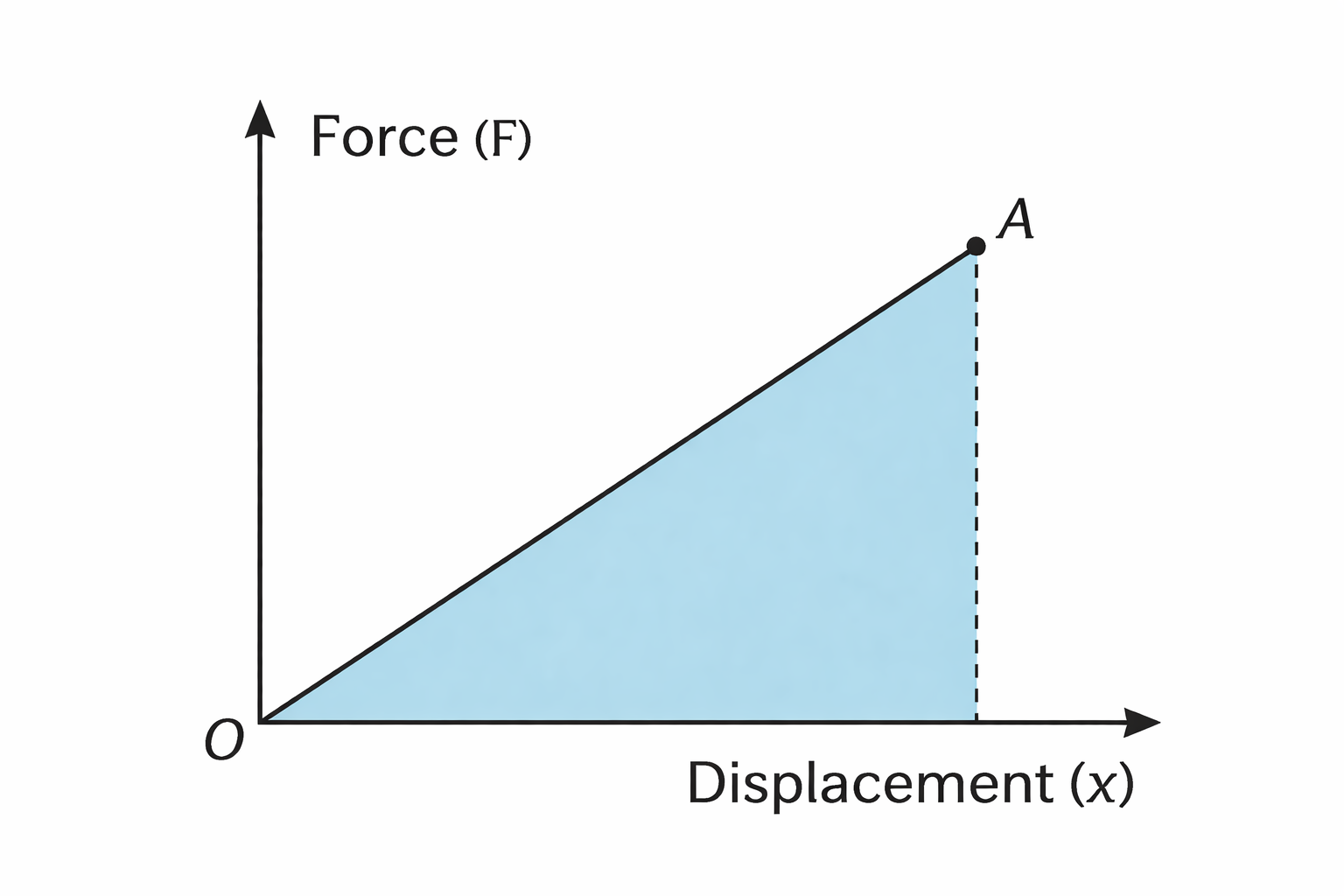
Graph Work done by a variable force = Area under graph
For a constant force: Area is a Rectangle ($W = F \times S$).
For a linear variable force: Area is a Triangle ($W = \frac{1}{2} F \times S$).
Q3. Write the expression for the work done by a force at an angle $\theta$.
Ans: $W = FS \cos \theta$.
Q4. A boy of mass $m$ climbs up the stairs of vertical height $h$. Work done?
Ans: $W = mgh$ (Work done against gravity).
A force of $10 \text{ N}$ acts on a body and displaces it through $2 \text{ m}$ in a direction at an angle $60^\circ$. Calculate work done.
Solution: $F=10, S=2, \theta=60^\circ \implies W = 10 \times 2 \times \cos 60^\circ = 20 \times 0.5 = 10 \text{ J}$.
When a body is moved vertically up or down, the force acting on it is its weight ($mg$).
where $h$ is the vertical height climbed or descended.
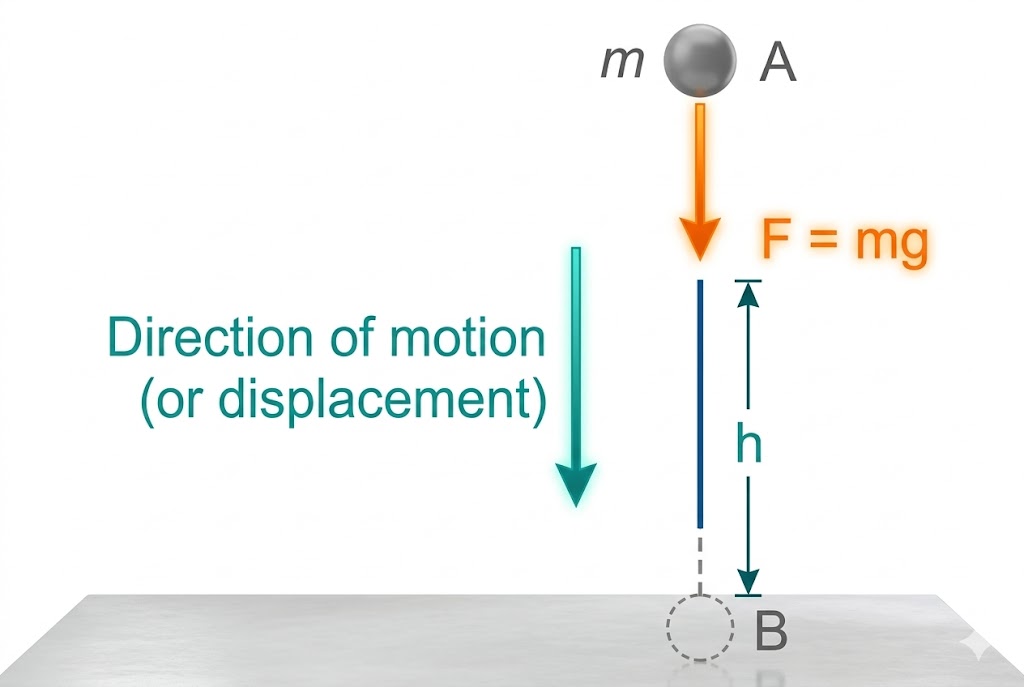
Fig 2.6 Work done against gravity in lifting a bucket
Important: If a body is moved horizontally (like a coolie on a platform), work done by gravity is zero because gravity acts vertically downwards ($\theta = 90^\circ$).
NUMERICAL A coolie lifts a load of 20 kg from the ground to a height of 1.5 m. Calculate the work done by him on the load. (Take $g = 10 \text{ m/s}^2$)
Solution: $W = mgh = 20 \times 10 \times 1.5 = 300 \text{ J}$.
Q: A coolie holding a heavy suitcase stands still for 5 minutes. Work done?
Ans: Zero. (No displacement, $S=0$).
A satellite revolves around the earth in a circular orbit. What is the work done by the force of gravity on the satellite? Give reason.
Ans: Work done is zero because the force of gravity is always perpendicular to the direction of motion (tangent).
SI Unit: The S.I. unit of work is joule (J).
$1 \text{ joule} = 1 \text{ newton} \times 1 \text{ metre}$.
Definition of 1 J: 1 joule of work is said to be done when a force of 1 newton displaces a body through a distance of 1 metre in its own direction.
CGS Unit: The C.G.S. unit of work is erg.
$1 \text{ erg} = 1 \text{ dyne} \times 1 \text{ cm}$.
Q5. Name the S.I. and C.G.S. units of work. How are they related?
Ans: S.I. unit is joule (J), C.G.S. unit is erg. Relation: $1 \text{ J} = 10^7 \text{ erg}$.
In our daily life, we often see that two persons or machines do the same amount of work, but one does it faster than the other. The rate of doing work is called power.
Wait! Since $W = F \times S$, we can rewrite this as:
$$ P = F \times \frac{S}{t} = F \times v $$(Power = Force $\times$ average speed)
| Work | Power |
|---|---|
| Work done by a force is equal to product of force and displacement. | Power of source is the rate of doing work. |
| It does not depend on time. | It depends on the time in which work is done. |
| S.I. unit is joule (J). | S.I. unit is watt (W). |
Q6. How is the power related to the force and speed?
Ans: Power = Force $\times$ speed ($P = Fv$).
Example 1: A crane pulls up a car of mass $500 \text{ kg}$ to a vertical height of $4 \text{ m}$. Calculate the work done. If it takes $20 \text{ s}$, calculate power. (Take $g = 9.8 \text{ m/s}^2$)
Solution:
Force required $F = mg = 500 \times 9.8 = 4900 \text{ N}$.
Work $W = F \times h = 4900 \times 4 = 19600 \text{ J}$.
Power $P = W/t = 19600 / 20 = 980 \text{ W}$ (or $0.98 \text{ kW}$).
Example: A boy of mass $40 \text{ kg}$ climbs 30 steps each $20 \text{ cm}$ high in $2 \text{ min}$, while a girl of same mass does it in $1.5 \text{ min}$. Compare: (i) work done, (ii) power developed. ($g = 10 \text{ m s}^{-2}$)
Solution:
Total height $h = 30 \times 0.20 = 6 \text{ m}$.
(i) Since mass and height are same, Work Done is same.
$\text{Ratio} = \mathbf{1 : 1}$.
(ii) Power $P \propto \frac{1}{t}$.
$\text{Ratio } P_1 : P_2 = t_2 : t_1 = 1.5 : 2 = \mathbf{3 : 4}$.
A body capable of doing work is said to possess energy. The energy possessed by a body is measured by the amount of work that the body can perform. When a body does work, its energy decreases, while if work is done on the body, its energy increases. Thus, whenever work is done, there is always a transfer of energy.
Definition: The energy of a body is its capacity to do work.
Like work, energy is also a scalar quantity.
The units of energy are same as that of work (joule and erg).
| Energy | Power |
|---|---|
| Capacity to do work is called energy. | Rate of doing work is called power. |
| It does not depend on time. | It depends on time. |
| S.I. unit is joule (J). | S.I. unit is watt (W). |
Q8. State the relationship between joule and eV.
Ans: $1 \text{ eV} = 1.6 \times 10^{-19} \text{ J}$.
In various devices, energy is converted from one form to another. This is known as energy transformation.
Q9. Name the device which converts: (a) Electric energy to Mechanical, (b) Chemical energy to Electric.
Ans: (a) Electric motor, (b) Electric cell (battery).
In any energy transformation, only a part of the energy is converted into the useful form. The remaining part is converted into some non-useful form (usually heat due to friction or sound) which is lost to the surroundings. This non-useful form of energy is called Degraded Energy.
The energy possessed by a body due to its state of rest or of motion, is called mechanical energy. It exists in two forms: (1) Potential Energy, and (2) Kinetic Energy. The total mechanical energy is the sum of both.
Definition: The energy possessed by a body by virtue of its changed position (or configuration) is called potential energy.
It is denoted by the symbol $U$. Examples: Stone at height, wound up watch spring, compressed spring, bent bow.
(1) Gravitational PE: Energy possessed by a body due to the force of attraction of earth on it. At a finite distance from earth, it is negative. At infinity, it is zero.
(2) Elastic PE: Energy possessed by a body in its deformed state due to configuration change. The body regains its shape on removing external force.
The gravitational PE of a body at a height is measured by the amount of work done in lifting it up from the ground to that height against gravity.
Weight of body = $mg$. Least upward force $F$ required to lift it (without acceleration) must be equal to $mg$.
Work done $W = F \times h = (mg) \times h = mgh$.
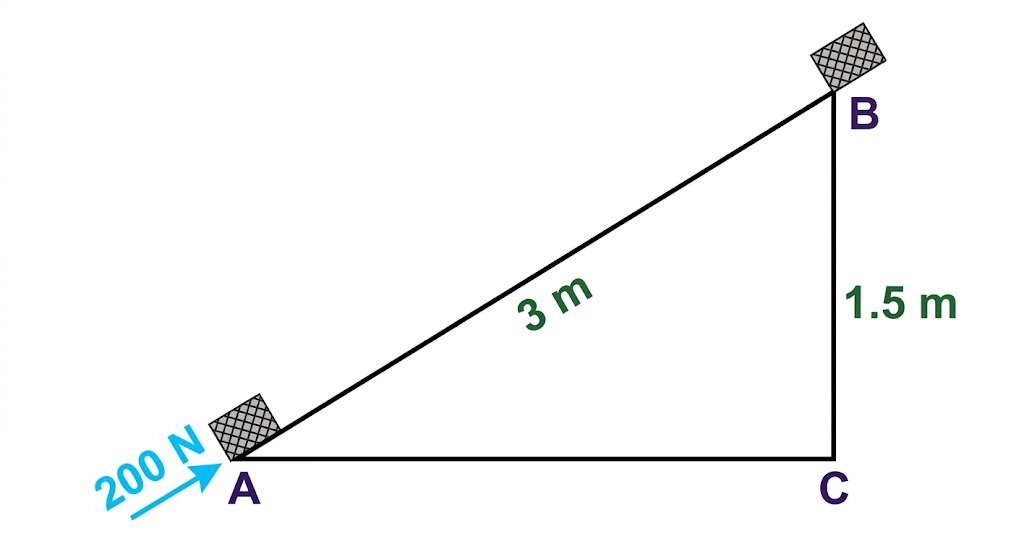
Q: A block of mass $30\text{ kg}$ is pulled up a slope length $3\text{ m}$ and height $1.5\text{ m}$ by a force $200\text{ N}$. Calculate: (i) Work, (ii) PE gained.
Solution:
(i) $W = 200 \times 3 = 600 \text{ J}$.
(ii) $\text{PE Gain} = 30 \times 10 \times 1.5 = 450 \text{ J}$.
The energy possessed by a body by virtue of its state of motion is called kinetic energy.
Expression / Derivation: Consider a body of mass $m$ at rest ($u=0$). A force $F$ is applied which produces acceleration $a$ and velocity $v$ after displacement $S$.
Work done $W = F \times S = (ma) \times (v^2/2a) = \frac{1}{2}mv^2$.
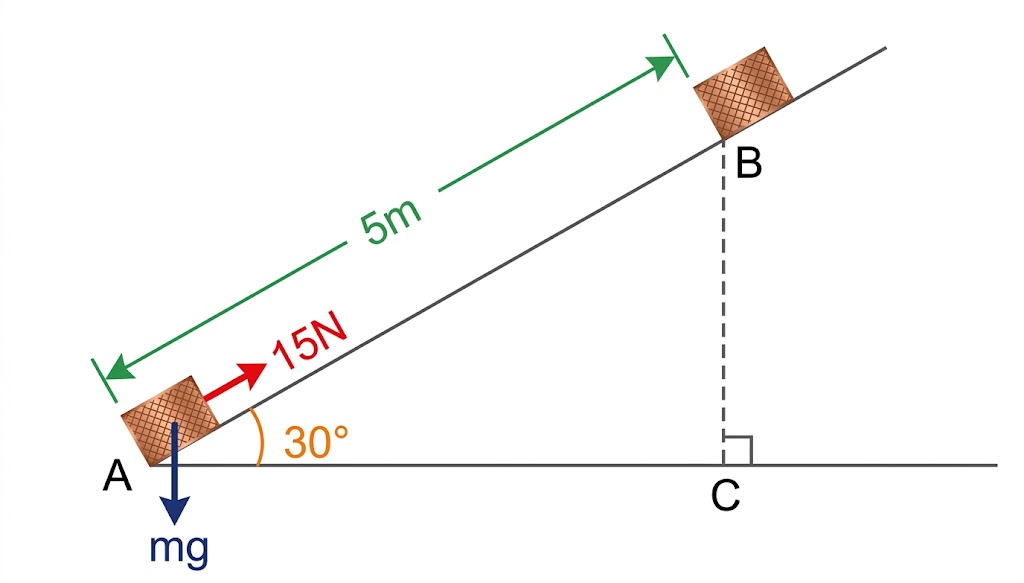
Fig 2.9 Different forms of kinetic energy
Q11. A body of mass $m$ is moving with velocity $v$. Write expression for its KE.
Ans: $K = \frac{1}{2} mv^2$.
A bullet of mass $5\text{ g}$ moving at $500\text{ m/s}$ penetrates a target by $10\text{ cm}$. Find average retarding force.
Solution: $K = \frac{1}{2} \times 0.005 \times 500^2 = 625 \text{ J}$.
$F = K/S = 625/0.1 = 6250 \text{ N}$.
A force of $15 \text{ N}$ is required to pull up a body of mass $2 \text{ kg}$ through a distance $5 \text{ m}$ along an inclined plane making an angle of $30^\circ$ with the horizontal. Calculate: (i) work done by force, (ii) work done against gravity. ($g = 9.8 \text{ m s}^{-2}$)
Solution:
(i) $\text{Work done by force } W = F \times S = 15 \times 5 = \mathbf{75 \text{ J}}$.
(ii) $\text{Vertical height } h = S \sin 30^\circ = 5 \times 0.5 = 2.5 \text{ m}$.
$\text{Work against gravity } W = mgh = 2 \times 9.8 \times 2.5 = \mathbf{49 \text{ J}}$.
| Potential Energy (U) | Kinetic Energy (K) |
|---|---|
| Possessed by virtue of changed position or configuration. | Possessed by virtue of state of motion. |
| Equal to work done in bringing it to that state. | Equal to work done it can do before coming to rest. |
The work done by a force on a moving body is equal to the increase in its kinetic energy ($W = \Delta K$).
Derivation: If force $F$ acts on mass $m$, acceleration $a = F/m$. From $v^2 = u^2 + 2aS \implies S = (v^2 - u^2)/2a$.
$W = F \times S = (ma) \times \frac{v^2-u^2}{2a} = \frac{1}{2}mv^2 - \frac{1}{2}mu^2$.
Potential energy changes into kinetic energy whenever it is put to use. Here are classic board-exam examples:
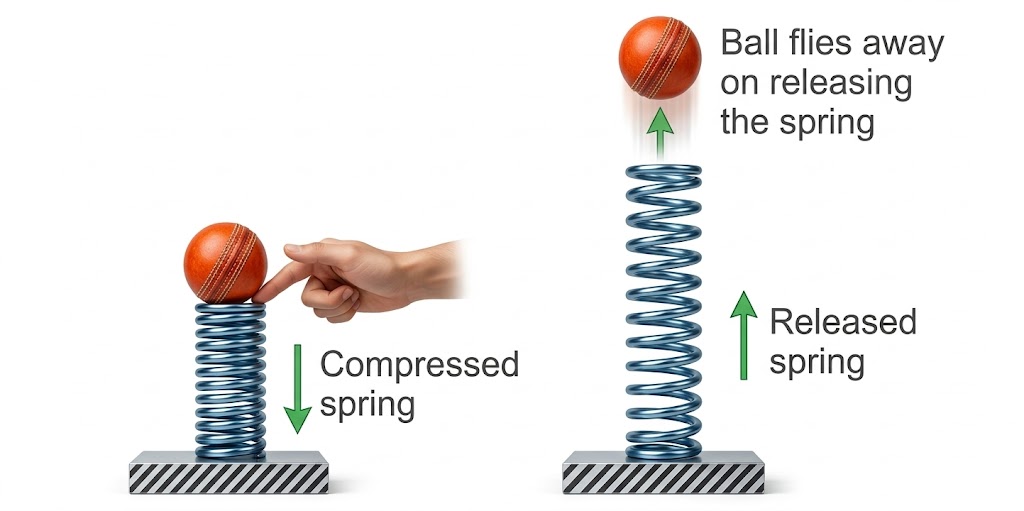
Fig 2.10 Ball flies away on releasing the spring
Energy exists in different forms like Solar, Heat, Light, Chemical, Nuclear, and Hydro energy.
Solar Energy: Energy radiated by the sun.
Chemical Energy: Energy stored in fuels like coal, petrol.
Energy often changes form during various physical and chemical processes.
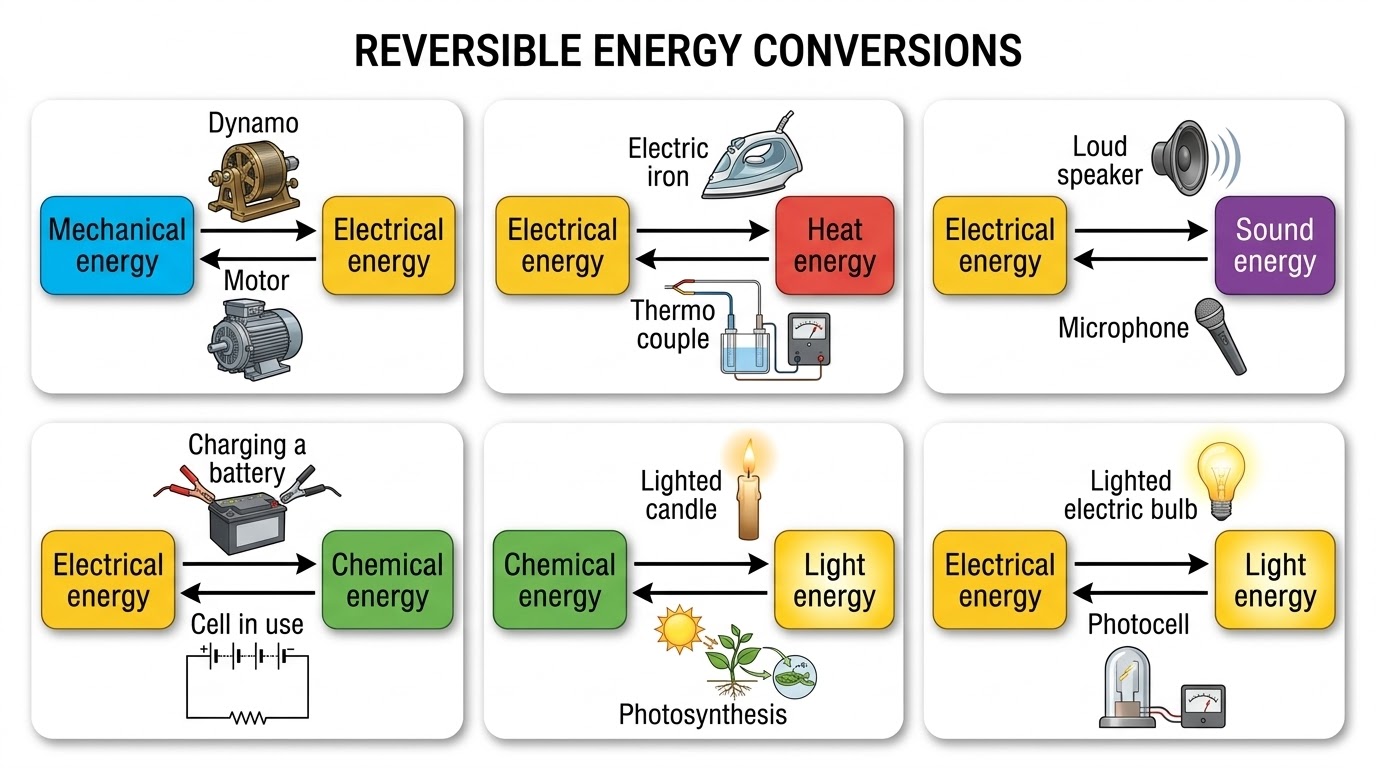
Fig 2.11 Examples of energy conversion
Definition: According to the principle of conservation of energy, energy can neither be created nor can it be destroyed. It only changes from one form to another.
In the universe, the sum of all forms of energy remains constant. If there is only an interchange between potential energy ($U$) and kinetic energy ($K$), the total mechanical energy remains constant.
$K + U = \text{constant}$ (In the absence of frictional forces)
Consider a body of mass $m$ falling freely from a height $h$ under gravity.
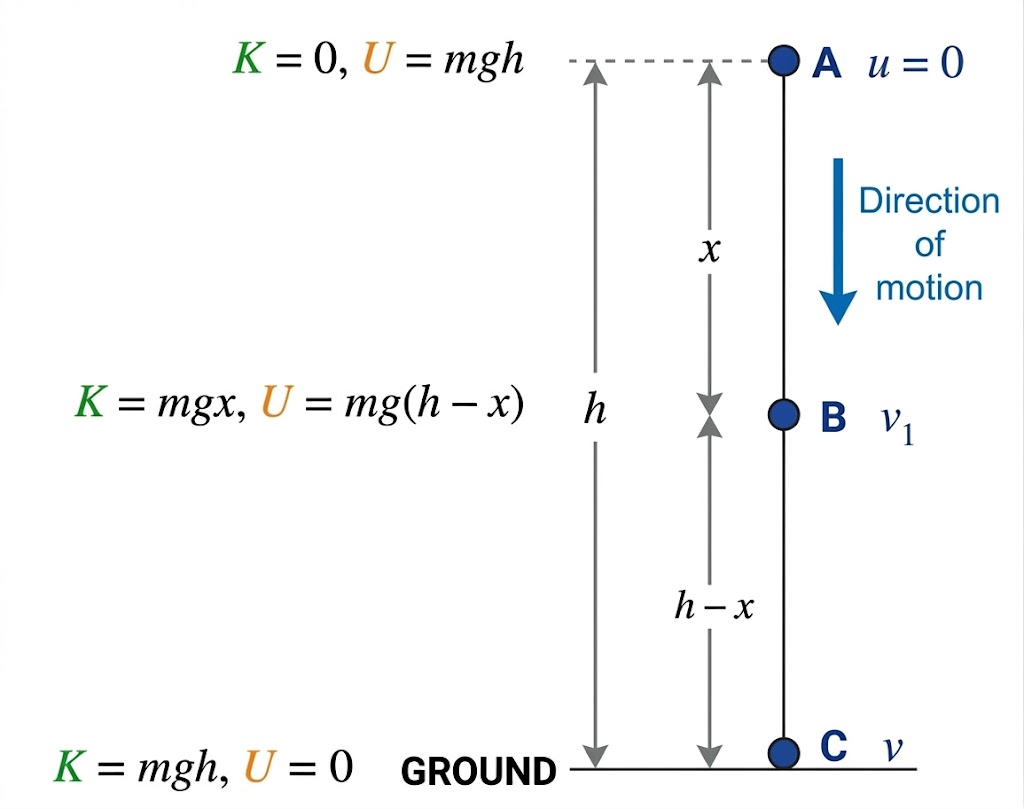
Fig 2.15 Energy conservation in free fall
1. At Position A (Height $h$):
Velocity $v=0 \implies K = 0$.
$U = mgh$.
Total Energy $E = 0 + mgh = mgh$.
2. At Position B (Height $h-x$):
Velocity $v_1^2 = 2gx$.
$K = \frac{1}{2}m(2gx) = mgx$.
$U = mg(h-x)$.
Total Energy $E = mgx + mg(h-x) = mgh$.
3. At Position C (Ground):
Velocity $v^2 = 2gh$.
$K = \frac{1}{2}m(2gh) = mgh$.
$U = 0$.
Total Energy $E = mgh + 0 = mgh$.
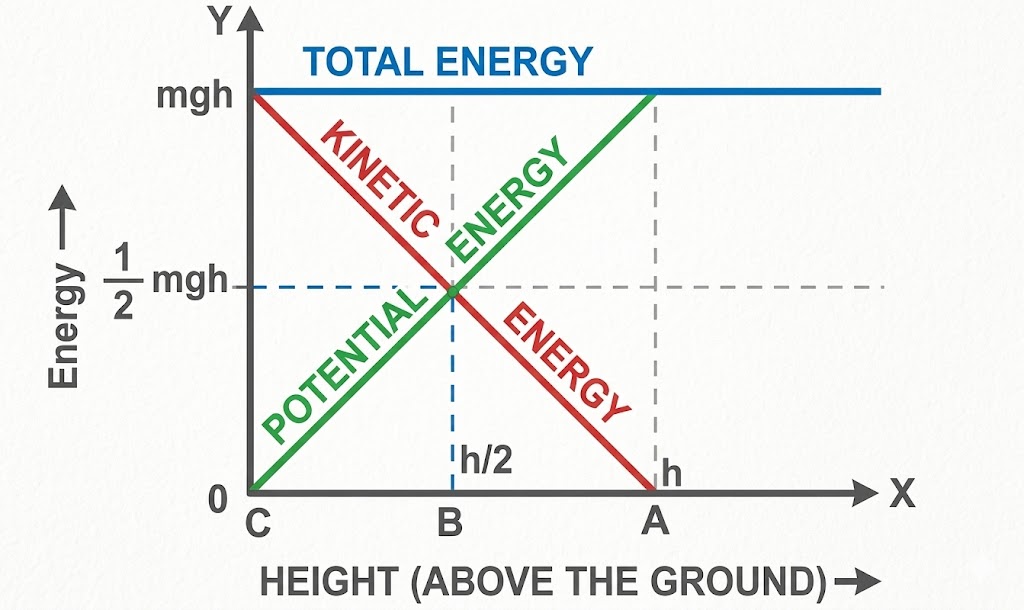
Fig 2.16 Transformation of energy in free fall
| Position | Height | Kinetic (K) | Potential (U) | Total (E) |
|---|---|---|---|---|
| A (Highest) | $h$ | 0 | $mgh$ | $mgh$ |
| B (Middle) | $h/2$ | $\frac{1}{2}mgh$ | $\frac{1}{2}mgh$ | $mgh$ |
| C (Ground) | $0$ | $mgh$ | 0 | $mgh$ |
Q: A body falls freely from rest. What energy does it possess:
(a) At the start? (b) While falling? (c) On reaching ground?
Ans: (a) Potential Energy only, (b) Both PE and KE, (c) Kinetic Energy only.
A simple pendulum consists of a small heavy mass (bob) suspended by a light string from a rigid support. Its energy oscillates between PE and KE.
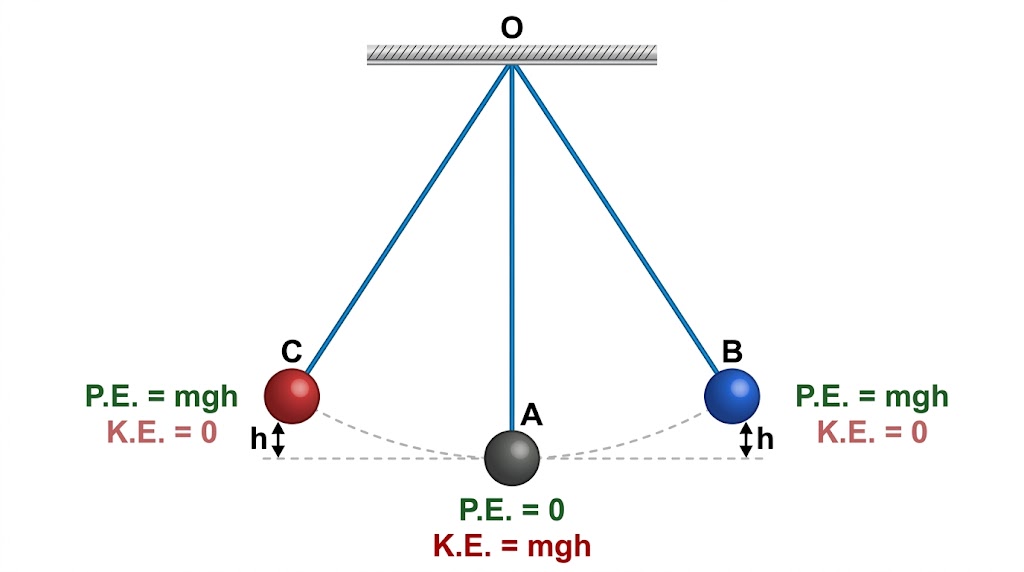
Fig 2.17 Energy conservation in a simple pendulum
A ball of mass $50 \text{ g}$ is thrown upwards with $20 \text{ m/s}$. Find maximum height reached if $40\%$ of initial energy is lost against air friction. ($g=10 \text{ m/s}^2$)
Solution:
Initial KE = $\frac{1}{2} \times 0.05 \times 20^2 = 10 \text{ J}$.
Energy available for PE = $60\% \text{ of } 10 \text{ J} = 6 \text{ J}$.
$mgh = 6 \implies 0.05 \times 10 \times h = 6 \implies h = 6/0.5 = 12 \text{ m}$.
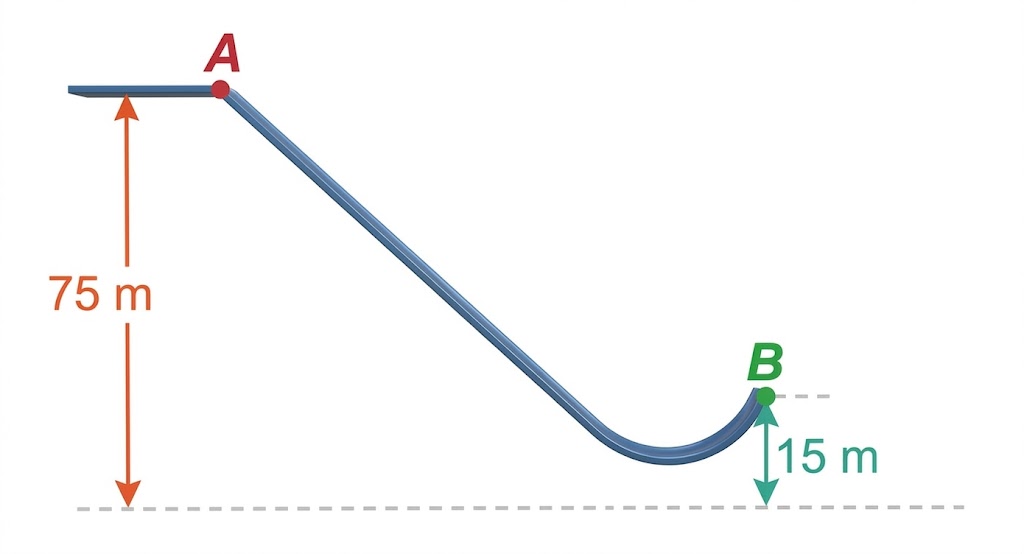
A skier weighing $60 \text{ kgf}$ stands at A ($75 \text{ m}$) and takes off at B ($15 \text{ m}$). Calculate: (i) change in PE, (ii) speed at B if $75\%$ energy becomes KE.
Solution:
(i) $\Delta U = mg(75-15) = 600 \times 60 = 36000 \text{ J} = 3.6 \times 10^4 \text{ J}$.
(ii) $K = 0.75 \times 36000 = 27000 \text{ J}$.
$\frac{1}{2} \times 60 \times v^2 = 27000 \implies v^2 = 900 \implies v = 30 \text{ m/s}$.
A hydro-electric station takes water from a lake at $50 \text{ m}$ height. If overall efficiency is $40\%$, calculate mass of water flowing per second to produce $1 \text{ MW}$ power.
Solution:
Power Needed = $10^6 \text{ W}$.
Useful work per kg = $0.40 \times (m \times 10 \times 50) = 200m \text{ J}$.
$200m = 10^6 \implies m = 5000 \text{ kg}$.
Q1: A force of $10 \text{ kgf}$ displaces a body by $0.5 \text{ m}$ in its own direction. Work done?
Ans: $W = 100 \times 0.5 = 50 \text{ J}$.
Q2: A boy of mass $40 \text{ kg}$ climbs $8 \text{ m}$ in $5 \text{ s}$. Power?
Ans: $P = mgh/t = 3200 / 5 = 640 \text{ W}$.
A weight lifter lifts $200 \text{ kgf}$ to $2.5 \text{ m}$ in $5 \text{ s}$. Power in HP?
Ans: $W = 5000 \text{ J}$, $P = 1000 \text{ W} = 1.34 \text{ HP}$.
In a dam, water falls at $1000 \text{ kg s}^{-1}$ from $100 \text{ m}$. Calculate power if efficiency is $60\%$.
Solution:
1s Potential Energy = $mgh = 1000 \times 10 \times 100 = 10^6 \text{ J}$.
Power Generated = $60\% \text{ of } 10^6 = 600,000 \text{ W} = 600 \text{ kW}$.
Fig 2.12 A block pulled up a slope
A block of mass $30 \text{ kg}$ is pulled up a slope of length $3 \text{ m}$ and height $1.5 \text{ m}$ with force $200 \text{ N}$. Calculate: (i) Work done by force, (ii) Potential energy gain.
Solution:
(i) $W = F \times \text{length} = 200 \times 3 = 600 \text{ J}$.
(ii) $U = mgh = 30 \times 10 \times 1.5 = 450 \text{ J}$.
(Note: $150 \text{ J}$ is lost against friction).
Q7: Kinetic energy of $2 \text{ kg}$ moving at $10 \text{ m s}^{-1}$?
Ans: $100 \text{ J}$.
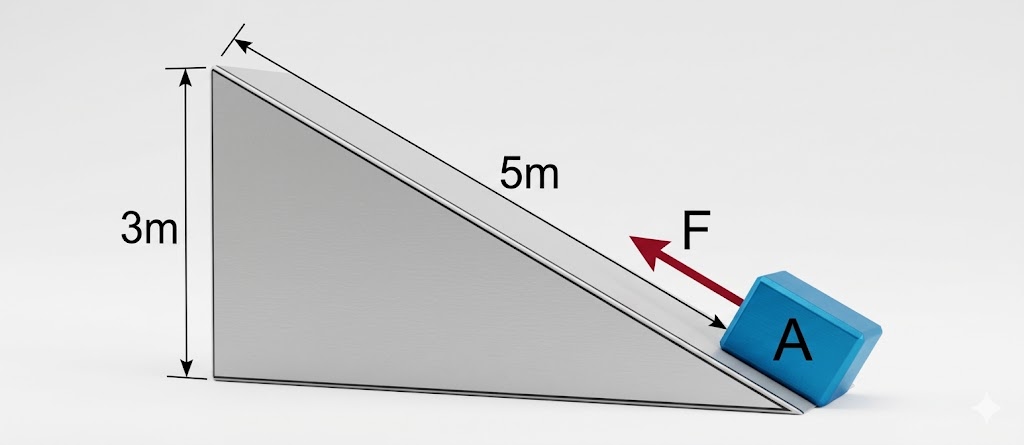
Fig 2.13 Force applied parallel to the slope
Q8: How fast should $60 \text{ kg}$ run so KE is $750 \text{ J}$?
Ans: $v = \sqrt{2 \times 750 / 60} = \sqrt{25} = 5 \text{ m s}^{-1}$.
Q9: If speed of a car is halved, how does its kinetic energy change?
Ans: Since $K \propto v^2$, if speed is halved ($v/2$), KE becomes $(1/2)^2 = 1/4$th of its original value.
Q10: A spring is kept compressed by a small trolley of mass $0.5 \text{ kg}$. On release, the trolley moves with speed $2 \text{ m/s}$. Initial PE?
Ans: $U = \text{KE gained} = \frac{1}{2} \times 0.5 \times 2^2 = 1 \text{ J}$.
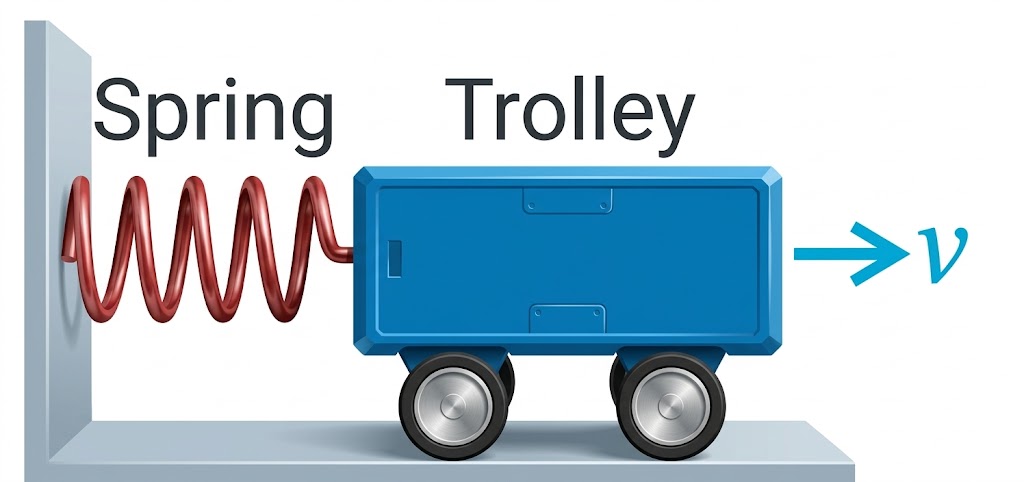
Fig 2.14 A spring kept compressed by a toy cart
Q11 (Rebound): A ball of mass $10\text{ g}$ falls from a height $5\text{ m}$ and rebounds to $4\text{ m}$. Find loss in KE on striking the ground. ($g=9.8 \text{ m/s}^2$)
Ans: Initial PE = $0.01 \times 9.8 \times 5 = 0.49\text{ J}$.
Final PE = $0.01 \times 9.8 \times 4 = 0.392\text{ J}$.
$\text{Loss in energy} = 0.49 - 0.392 = 0.098\text{ J}$. (This energy appears as heat and sound).
Practice makes perfect. Review the numericals thrice.
Created by Team Vardaan with ❤️
Powered by vardaan comet