
Created by Team Vardaan with ❤️ • Class IX
This chapter explores the fundamental concepts of Magnetism, focusing on how magnets influence materials and how the Earth itself acts as a giant magnet. We will cover:
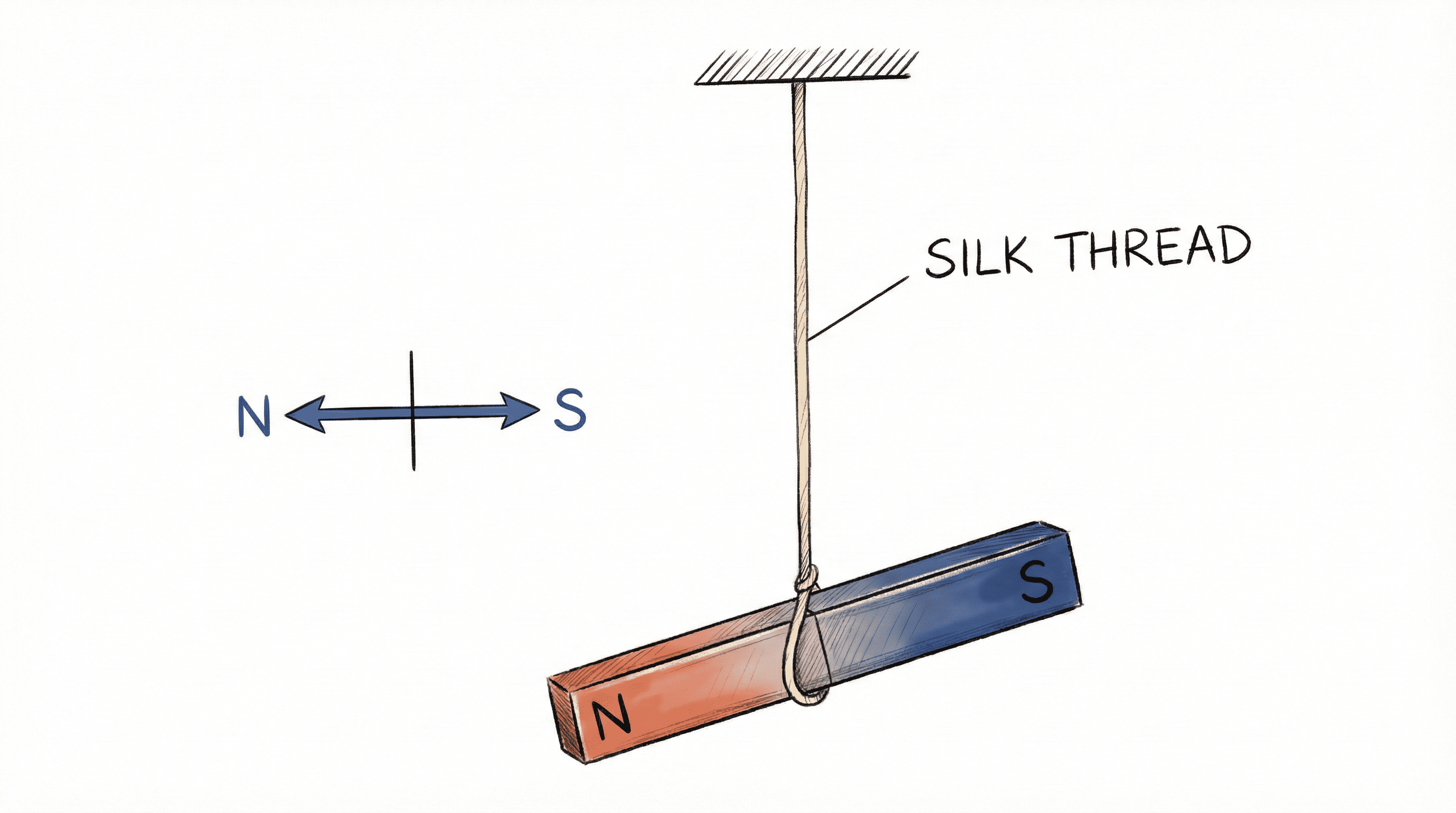
The first known magnets were pieces of lodestone, an ore of iron oxide ($Fe_3O_4$), found in Magnesia (Asia Minor). This ore was found to possess two key properties:
Natural magnets are often irregular and weak. Thus, we use Artificial Magnets (Bar magnets, Horse-shoe magnets, Magnetic needles) made from iron or steel, which are stronger and have convenient shapes.
Test for Magnetism: A magnet can attract both an unmagnetised iron piece and an opposite pole of another magnet. However, repulsion only occurs between two like poles. Thus, Repulsion is the surest test of magnetism.
.png)
Definition: The temporary magnetism acquired by a magnetic substance (like soft iron) when it is kept near or in contact with a magnet is called Induced Magnetism.
When an unmagnetised iron bar is placed near a magnet, it acquires magnetic properties. The end of the bar near the magnet develops opposite polarity (e.g., if near South pole, it becomes North), while the farther end develops similar polarity.
"Induction Precedes Attraction" - IMPORTANT!
A magnet does not attract a piece of iron directly. First, it induces opposite polarity on the near end of the iron piece (Induction). Since unlike poles attract, the induced opposite pole is then attracted to the magnet. Thus, induction always takes place before attraction.
.jpg)
If a bar magnet is brought near small iron nails, they form a chain as shown in Fig 10.3. The magnet induces magnetism in the first nail, which induces it in the second, and so on. If the top magnet is removed, all nails fall, proving that induced magnetism is temporary.
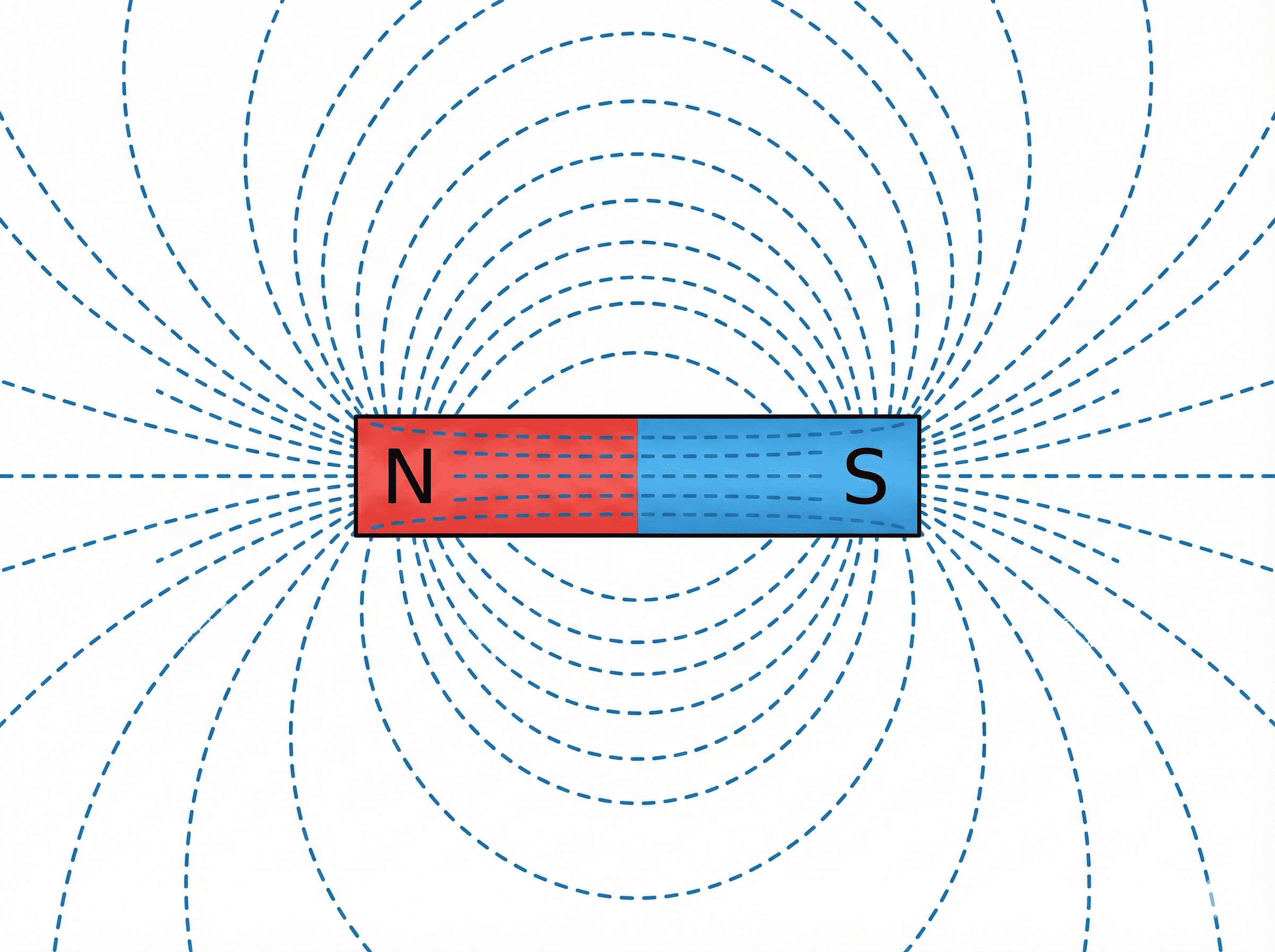
The space around a magnet in which its magnetic influence can be experienced is called its Magnetic Field. It is a vector quantity having both magnitude and direction.
.png)
Why can't two lines intersect? If they did, at the point of intersection, there would be two tangents representing two different directions of the magnetic field, which is impossible.
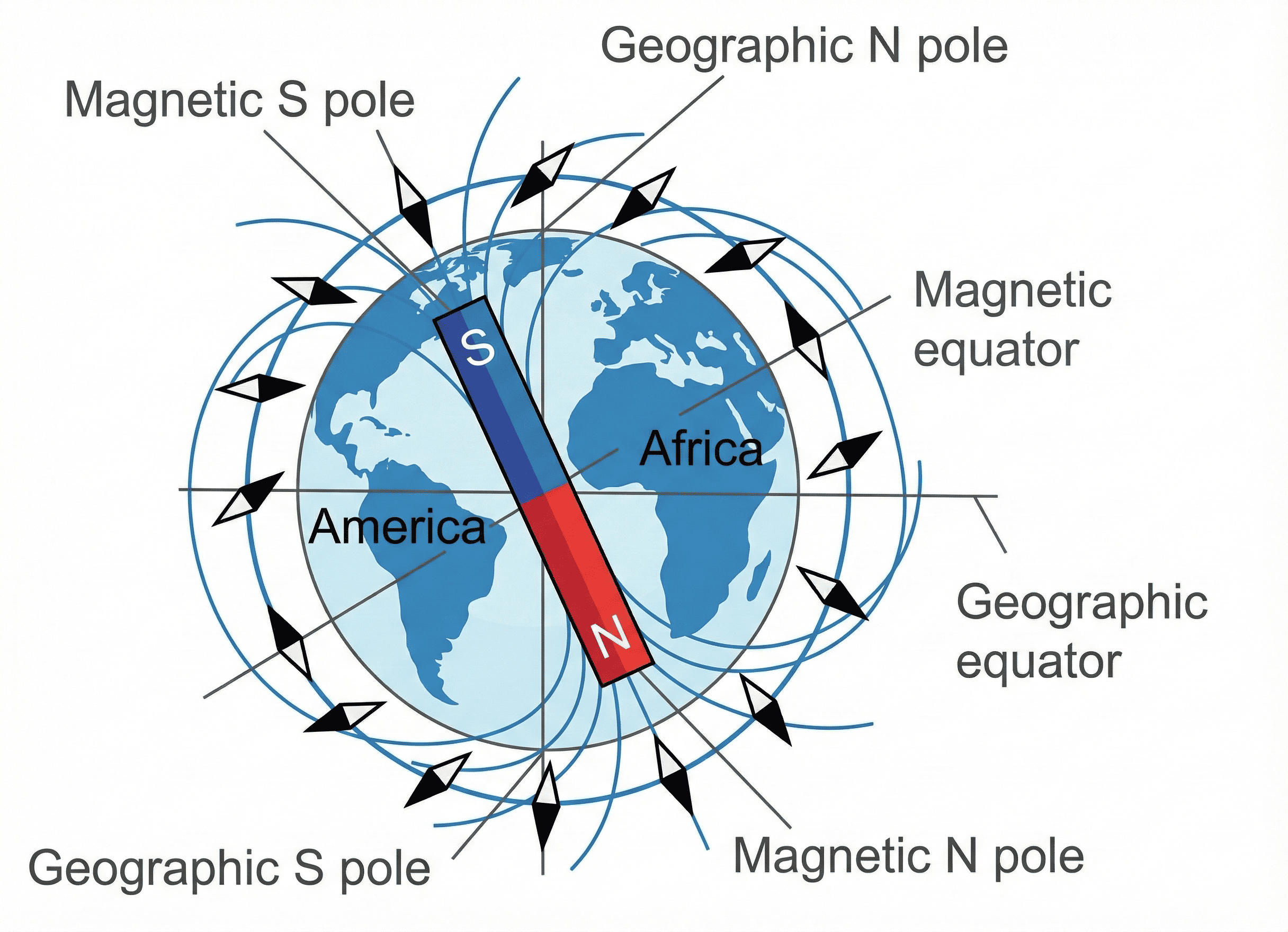
The Earth acts as a huge magnet with its magnetic North pole situated near the geographic South pole and vice-versa. This is why a compass points North (it's attracted to Earth's magnetic South pole located there).
Earth's magnetic field lines are parallel and equidistant in a limited space, representing a Uniform Magnetic Field.
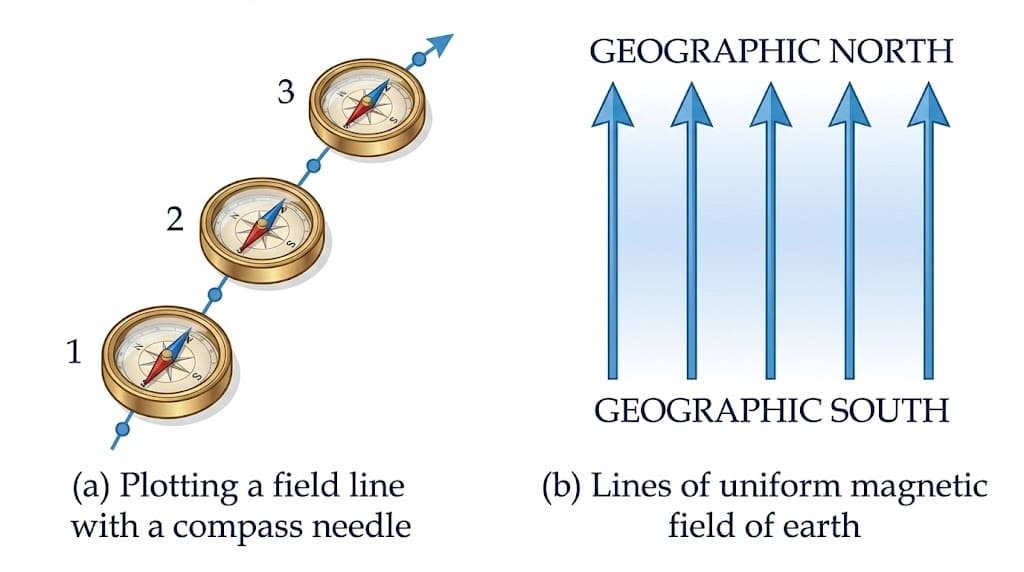
The magnetic field around a bar magnet is non-uniform (the lines are curved). The lines are crowded near poles where the field is strong and spaced out where it is weak.
 Bar magnet (b) Horse-shoe (c) Unlike poles (d) Like poles.png)
Neutral Points (X): Points where the net magnetic field is zero. This happens when the magnetic field produced by the magnet is equal in magnitude and opposite in direction to the horizontal component of the Earth's magnetic field ($B_H$).
 & Neutral Points (East-West).png)
In this position, the neutral points lie on the Equatorial line (axis perpendicular to the magnet's length) on either side of the magnet.
 & Neutral Points (North-South).png)
In this position, the neutral points lie on the Axial line (axis along the magnet's length) on either side of the magnet.
An electromagnet is a temporary magnet made by passing current through a coil wound around a soft iron core. It behaves as a magnet only as long as current flows.
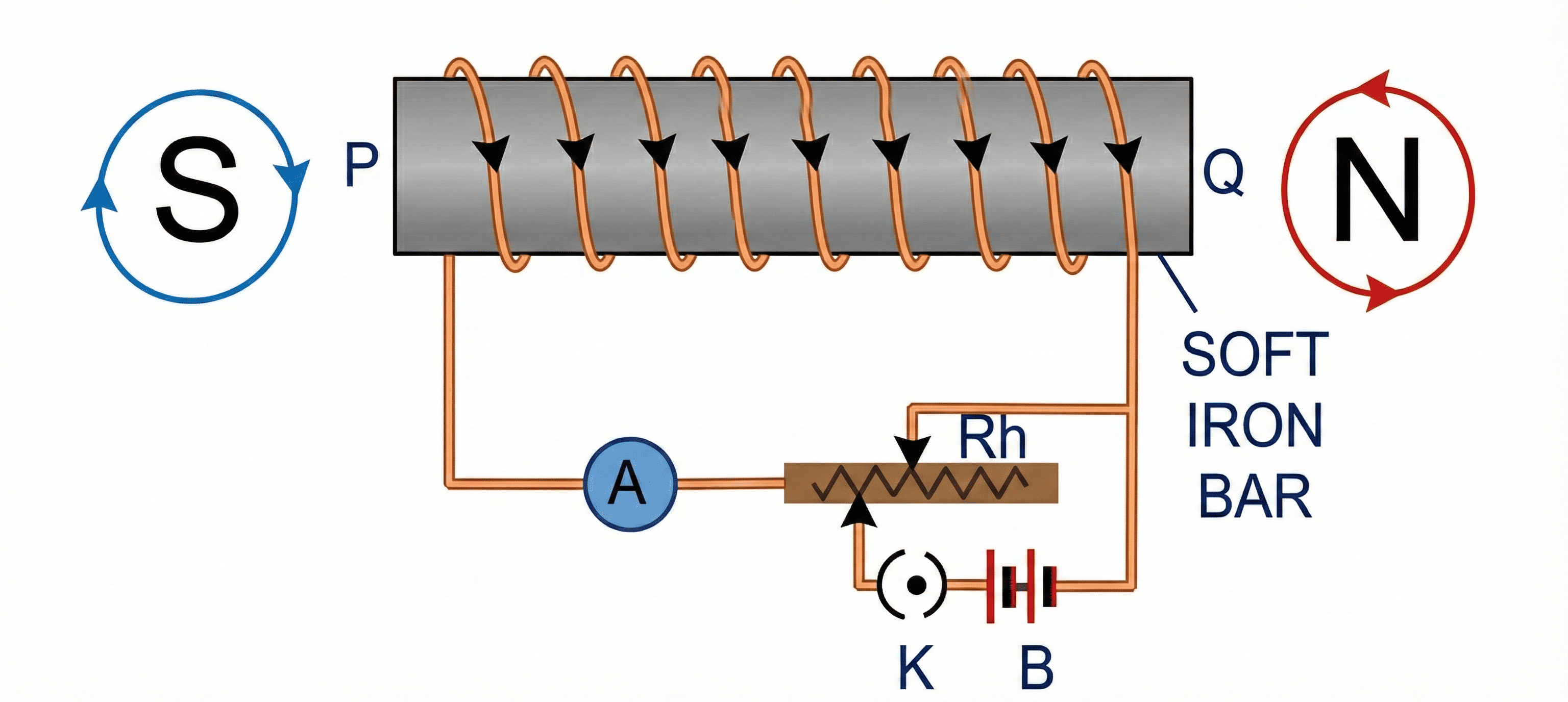
It consists of a thin soft iron bar around which an insulated copper wire is wound in the form of a solenoid.
When current is passed, the bar gets magnetised.
Polarity Rule: Looking at a face, if current is Clockwise, it becomes
a South Pole. If Anticlockwise, it becomes a North Pole.
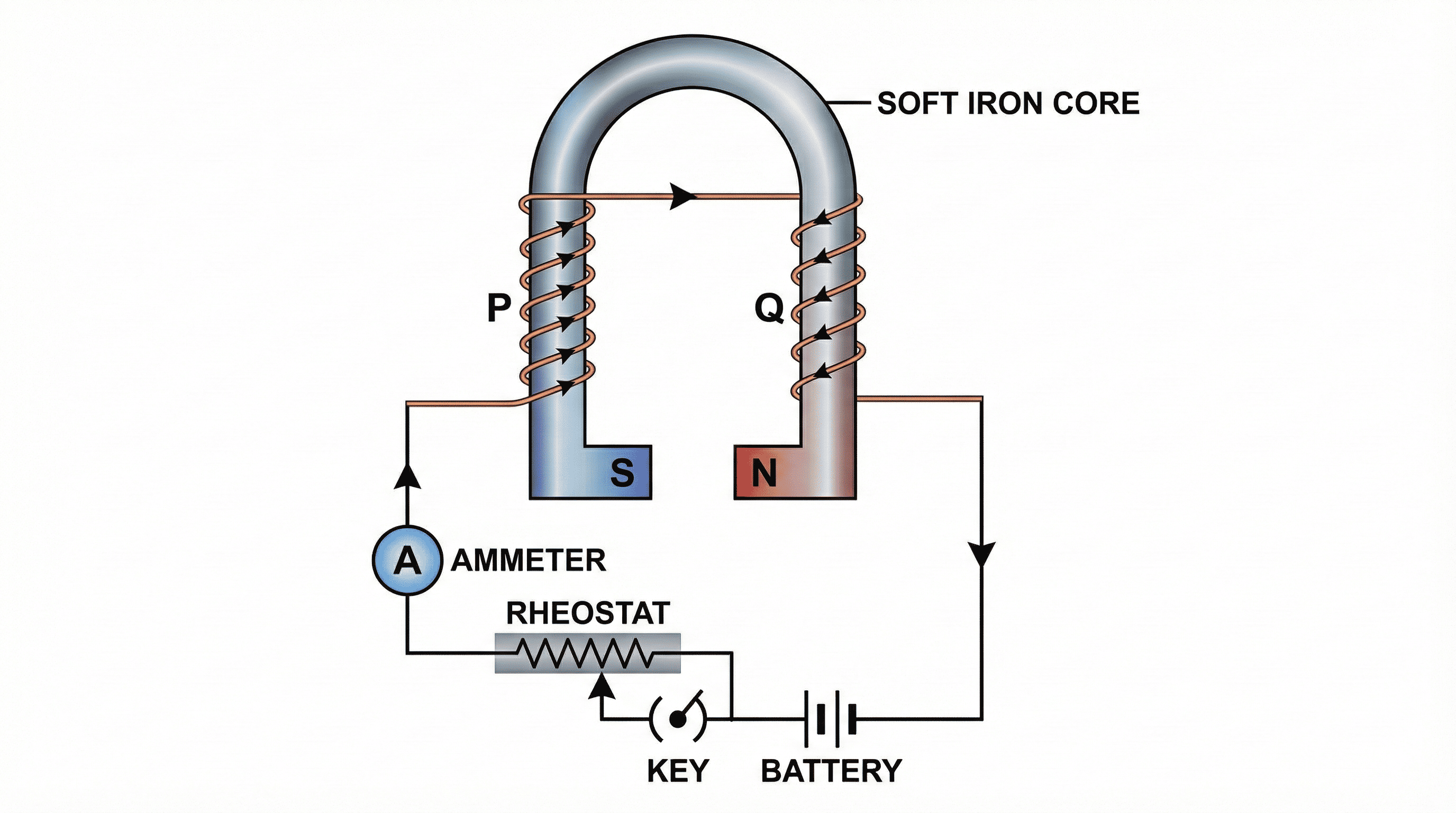
It consists of a U-shaped soft iron core. The wire is wound on the two arms such that the current flows in opposite directions in the two arms (when viewed from the ends). This creates a North pole at one end and a South pole at the other. It is stronger than a bar electromagnet due to the smaller air gap.
| Electromagnet (Temporary) | Permanent Magnet (Steel) |
|---|---|
| Made of Soft Iron. | Made of Steel. |
| Magnetism is temporary (lost when current stops). | Magnetism is permanent. |
| Strength can be varied (by changing $I$ or $N$). | Strength is fixed. |
| Polarity can be reversed. | Polarity is always fixed. |
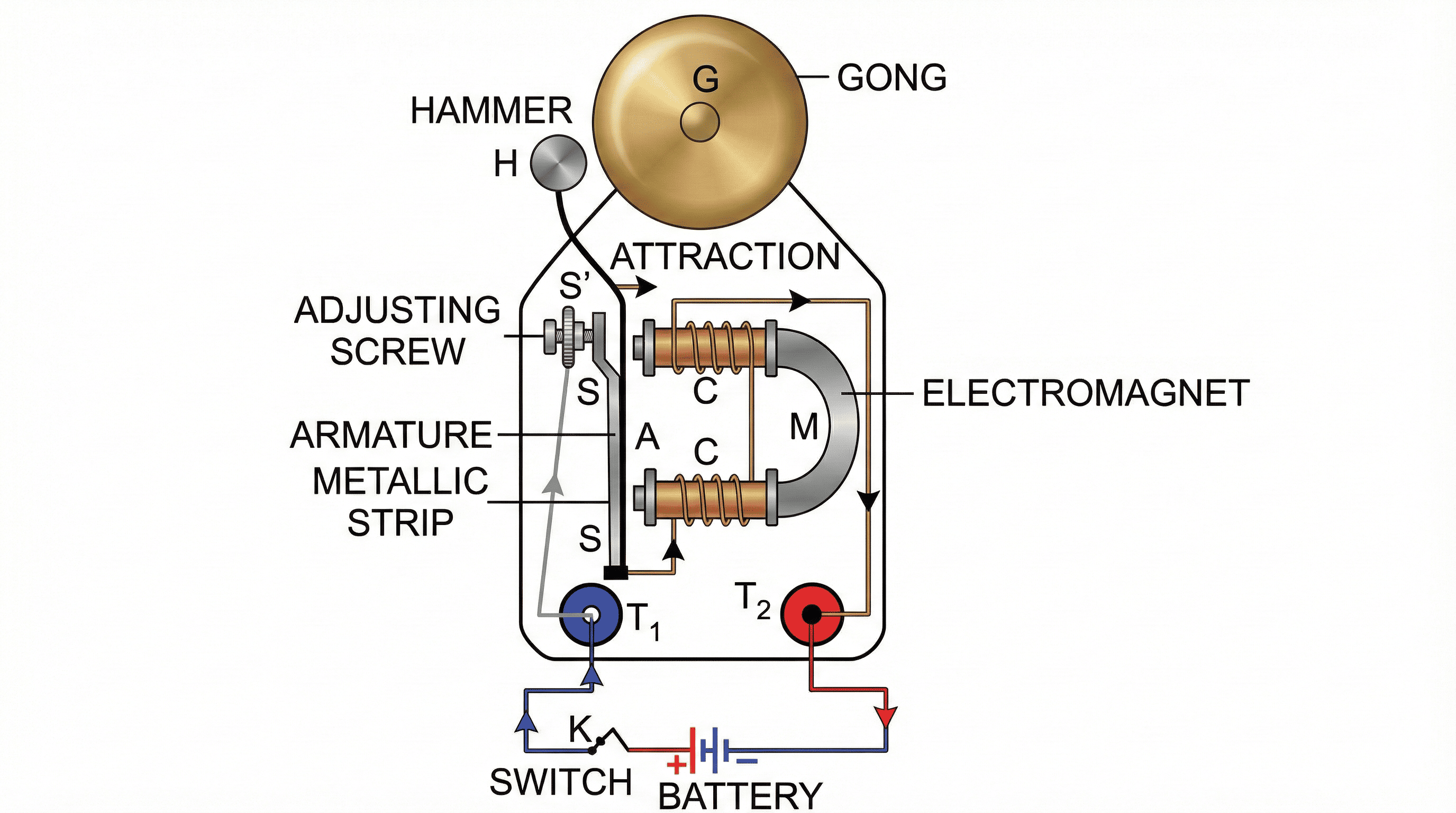
Principle: It works on the magnetic effect of current (Electromagnetism).
Created by Team Vardaan with ❤️